
 |
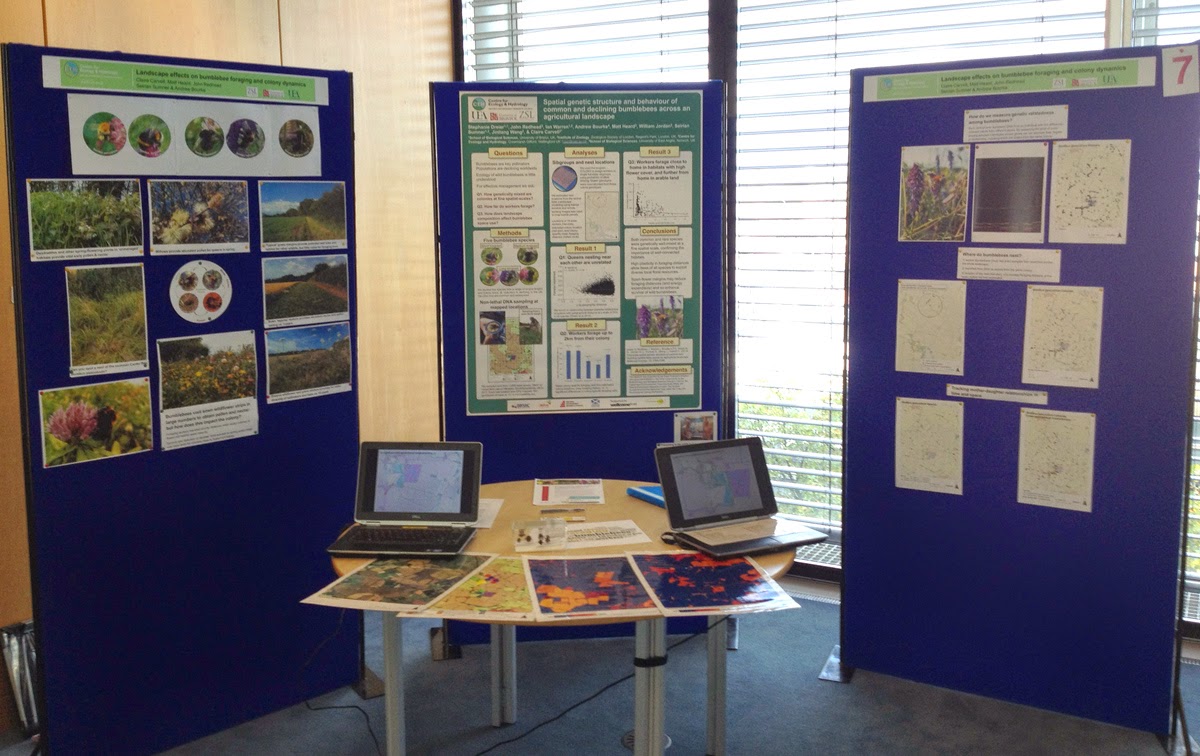
| Claire Carvell, Matt Heard and John Redhead of CEH put together a stand to highlight their research activities for the Insect Pollinators Initiative |
The IPI, which ran from late 2010, funded a number of research projects investigating the causes and consequences of insect pollinator decline.
To date, the IPI projects have produced more than 40 new research papers.
Wow! 47 research papers on #bees and #pollinators thanks to Insect Pollinators Initiative @BBSRC @wellcometrust pic.twitter.com/coQrVlLtNe
— Rob Dawson (@UKBioNews) October 21, 2014
Dr Adam Vanbergen of the Centre for Ecology & Hydrology (CEH) was scientific coordinator of the IPI and spoke at the dissemination event.
Dr Adam Vanbergen sums up the decline of #bees and other #pollinators at Insect Pollinators Initiative launch event pic.twitter.com/38UG42HTai
— Paul De Zylva (@pauldezylva) October 21, 2014
RT @WaspWoman: Adam Vanbergen. Bee diversity has decreased in 52% of UK landscapes since 1980. UK #redlist has 71 spp. #bees @wellcometrust
— Scoutbee (@scout_bee) October 21, 2014
"Bee diversity has declined in over half of UK landscapes since 1980" Dr Vanbergen, Insect Pollinators Initiative pic.twitter.com/vAARgnwNky
— Paul De Zylva (@pauldezylva) October 21, 2014
CEH's Dr Claire Carvell led an IPI-funded project to investigate how habitat structure affected queen and worker bumblebees in the field, collaborating with CEH colleagues and researchers from UEA, the Zoological Society of London and Bristol University.
Scientists from CEH also collaborated on a project led by the University of Leeds, “Linking agriculture and land use change to pollinator populations”. The following tweets give a flavour of some of the results produced from the research.
Getting ready for our #bumblespace session at #pollinators mtg @wellcometrust @BristolUni @CEHScienceNews @ZSLScience pic.twitter.com/naq7woO2Lw
— Seirian Sumner (@WaspWoman) October 21, 2014
Claire Carvell from @CEHScienceNews explains hie habitat affects how far #bumblebees fly. #bumblespace @wellcometrust pic.twitter.com/9HoeU5oGmF
— Seirian Sumner (@WaspWoman) October 21, 2014
@RedheadGIS: Which areas are 'hot spots' for summer bumblebee food? #bumblespace @CEHScienceNews @wellcometrust pic.twitter.com/EfEZD3KmyA
— John Redhead (@RedheadGIS) October 21, 2014
Claire Carvell: 1-3% of landscape needs to be 'good quality' forage to ensure colonies can forage effectively. #bumblespace @CEHScienceNews
— Seirian Sumner (@WaspWoman) October 21, 2014
Claire Carvell: How far do #bumblebees fly? Up to 2km, but lots of variation among species. #bumblespace #pollinators @CEHScienceNews
— Seirian Sumner (@WaspWoman) October 21, 2014
Defra Chief Scientist Ian Boyd was among those at the event.
Yesterday I spoke at the Insect Pollinators Initiative. IPI outputs are being used to inform the development of National Pollinator Strategy
— DefraChiefScientist (@DefraChiefScien) October 22, 2014
The National Pollinator Strategy will be launched this Autumn.
* The Insect Pollinators Initiative was launched in 2010 and funded nine research projects worth up to £10million. It was a joint initiative from BBSRC, Defra, NERC, the Scottish Government and the Wellcome Trust, and was funded under the auspices of the Living With Environmental Change partnership.
Related CEH news stories
Queen bumblebees disperse far from their birthplace before setting up home, DNA analysis reveals
Ecologists get first bumblebees' eye view of the landscape
Cocktail of multiple pressures combine to threaten the world’s pollinating insects


