Showing posts with label pollinators. Show all posts

Wednesday, 5 November 2014

National Pollinator Strategy and related CEH science

The National Pollinator Strategy was launched yesterday (4 November 2014) by Environment Minister Liz Truss. The strategy has been many months in the making and appears (judging by reactions reported in the media such as on the BBC and in the Guardian) to have widespread, if occasionally qualified, support from a large number of organisations and individuals.

The Centre for Ecology & Hydrology (CEH) is one of two academic partners represented on the Stakeholder Advisory Group for the strategy project and our science is integral to delivering its aims.

References in the strategy to CEH work include:

The National Pollinator Strategy refers to an existing evidence base, and makes a number of comments on future evidence requirements. The strategy is intended to lay out a 10-year roadmap for actions and lays out a number of key evidence gaps.


The science carried out at the Centre for Ecology & Hydrology is crucial to both understanding the current evidence base and addressing those gaps. In addition to the ongoing projects mentioned above, over the next five years scientists at CEH will:

  • Develop and test a new systematic and sustainable monitoring framework for pollinators to be implemented by professionals and by using a “citizen science” approach involving volunteers logging observations and gathering other evidence*.
  • Undertake research to quantify the impact on honeybees of two commercial neonicotinoids seed treatments in commercially grown crops of oilseed rape (‘Clothianidin’ Bayer CropScience and ‘Thiamethoxam’ Syngenta). CEH researchers have designed, and are overseeing the delivery of this pan-European, field experiment.

*The project was commissioned by Defra in summer 2014 and is being undertaken by the Centre for Ecology & Hydrology, Leeds University, Reading University and the Open University, and entomology experts (Hymettus) and volunteers from recording schemes and societies (Bees Wasps and Ants Recording Society; Hoverfly Recording Scheme; Bumblebee Conservation Trust; Butterfly Conservation and British Trust for Ornithology).

Additional information


National Pollinator Strategy: for bees and other pollinators in England

Plan bee: New measures to protect pollinators BBC News - 4 November 2014

Will the UK's pollinator strategy be enough to stop bee decline?  The Guardian - 4 November 2014

Insect Pollinators Initiative Dissemination Event CEH blog post - 24 October 2014

Friday, 24 October 2014

Insect Pollinators Initiative Dissemination Event

The end of the UK Insect Pollinators Initiative (IPI)* was marked by an event at the Wellcome Trust on 21 October 2014. Attendees included Government Chief Scientist Sir Mark Walport and Ian Boyd, Defra Chief Scientist, as well as scientists from the various projects funded under the initiative.

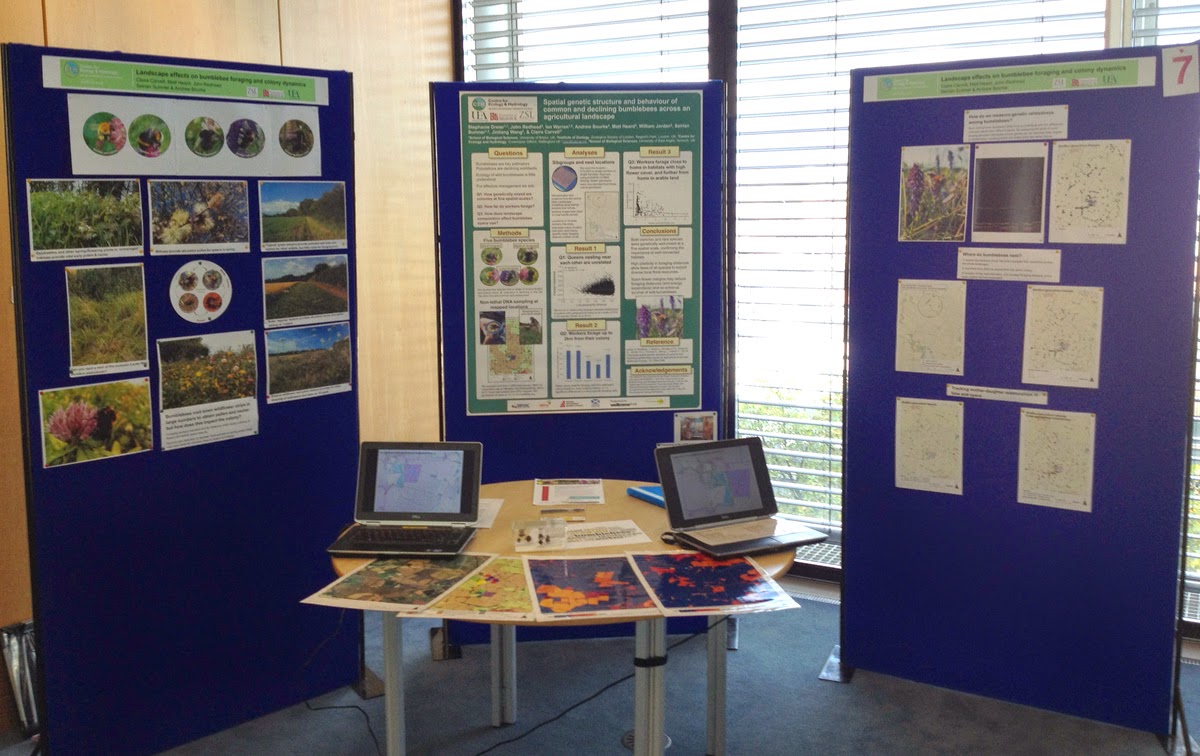
Claire Carvell, Matt Heard and John Redhead of CEH put together a stand to highlight
their research activities for the Insect Pollinators Initiative

The IPI, which ran from late 2010, funded a number of research projects investigating the causes and consequences of insect pollinator decline.

To date, the IPI projects have produced more than 40 new research papers.


Dr Adam Vanbergen of the Centre for Ecology & Hydrology (CEH) was scientific coordinator of the IPI and spoke at the dissemination event.


CEH's Dr Claire Carvell led an IPI-funded project to investigate how habitat structure affected queen and worker bumblebees in the field, collaborating with CEH colleagues and researchers from UEA, the Zoological Society of London and Bristol University.

Scientists from CEH also collaborated on a project led by the University of Leeds, “Linking agriculture and land use change to pollinator populations”. The following tweets give a flavour of some of the results produced from the research.


Defra Chief Scientist Ian Boyd was among those at the event.


The National Pollinator Strategy will be launched this Autumn.

* The Insect Pollinators Initiative was launched in 2010 and funded nine research projects worth up to £10million. It was a joint initiative from BBSRC, Defra, NERC, the Scottish Government and the Wellcome Trust, and was funded under the auspices of the Living With Environmental Change partnership.

Related CEH news stories


Queen bumblebees disperse far from their birthplace before setting up home, DNA analysis reveals 

Ecologists get first bumblebees' eye view of the landscape

Cocktail of multiple pressures combine to threaten the world’s pollinating insects

Tuesday, 10 June 2014

Building a buzz around the Big Bumblebee Discovery

Viewers of Sky News Sunrise were given a buzz this morning when Dr Helen Roy of CEH took to the studio with science presenter Dallas Campbell to talk about the fantastic Big Bumblebee Discovery citizen science project. Helen and CEH colleague Dr Michael Pocock are helping to run the project, which will use the data collected to address the question of how bees are affected by their immediate surroundings and the wider landscape.


The Big Bumblebee Discovery is the first project in the Great EDF Energy experiment, a collaboration between the British Science Association and EDF Energy.

Watch a video of their appearance on Sunrise here (also featuring the superb tree bumblebee model first seen at last year’s Gardeners’ World show!).

Helen and Dallas are having a busy few days both in encouraging children, teachers and parents to sign up to what is a fun and interesting initiative, but also in explaining the scientific usefulness of this hypothesis-led project. The pair were at the Cheltenham Science Festival on Saturday 8 June to talk to visitors to the EDF Energy Zone, where Big Bumblebee Discovery posters, games and other activities were available. (Michael had also visited a few days earlier to lend his encouragement to the hundreds of visiting school children, with many a budding citizen scientist among them).

Visitors to the Cheltenham Science Festival had a chance to learn about
the Big Bumblebee Discovery. Photo: Val Woods


And following their Sky News Sunrise appearance, expect to hear more from Helen and Dallas enthusing about the project on a local radio station near you.

Helen and Dallas record a BBC radio interview to explain more about getting
involved in the Big Bumblebee Discovery. Photo courtesy EDF Energy Comms


What’s it all about?


Bumblebees are prolific pollinators, but it’s believed that environmental changes are causing declines in some bumblebee populations.

The Big Bumblebee Discovery will provide an opportunity for school children through EDF Energy’s ‘The Pod’ programme to get involved in “real science”. Thousands of schools across the country are invited to observe and record colour groups of bumblebees visiting a standard-sized lavender plant. The CEH scientists, alongside the participants, will use the data to address the question: “how does landscape (at multiple scales) affect the diversity of bumblebees?”

  • The nationwide initiative involves children and parents counting the number and types of bumblebee they spot in their garden, school playground or local park.
  • Results will be used by CEH researchers to map bumblebee numbers across Britain and what impact the landscape has on bumblebee diversity.
  • The Big Bumblebee Discovery is the first project in the Great EDF Energy Experiment, a five-year programme launched in partnership with the British Science Association. The initiative is designed to inspire children to think differently about science, technology, engineering

Utilising a citizen science approach – the method of using a large number of researchers to each collect a sample of data – the Big Bumblebee Discovery is an exciting opportunity for thousands of young people to become scientists in their own back garden.


Don't forget to sign up by logging on to www.beediscovery.org. The first 3,000 schools to sign up to the experiment will receive a free lavender plant and engagement pack containing a range of fantastic resources to help them along the way – but anyone who signs up to The Pod to register interest in participating will be able to get their hands on a range of great tools to help them with the experiment.

Additional links


Bees and 'ologies at the Cheltenham Science Festival - CEH blog

The Pod programme from EDF Energy

Staff page of Dr Helen Roy

Staff page of Dr Michael Pocock

Posted by Paulette Burns

Friday, 20 December 2013

The top 10 most viewed CEH news & blog posts of 2013

We hope you've found our content interesting and informative throughout the year but, of course, not everything will be to everyone's tastes. Here is a little (slightly unscientific!) insight into what news and blogs you were reading the most in 2013, in traditional reverse order:

Top 10 most viewed news stories


10. Distinctly autumnal feel to May as below average temperatures persist
The cold spring was still hanging around, but a warm summer wasn't too far away.

9. Ecologists get first bumblebees' eye view of the landscape
Scientists produced the most detailed picture yet of how bumblebees use the landscape, thanks to DNA technology and remote sensing.

8. Introducing the Hydrological Outlook
CEH and a number of partners had been working for a while on developing a long-range hydrological forecast for the UK.

7. Cocktail of multiple pressures combine to threaten the world's pollinating insects
Not one cause, but a combination of pressures including pesticides, disease and loss of food resources are threatening insect pollinators such as bumblebees and honeybees.

6. Are tropical forests resilient to global warming?
Tropical forests are less likely to lose biomass in response to greenhouse gas emissions over the 21st century than may previously have been thought.

5. Britain's rarest freshwater fish, the Vendace, reappears in Bassenthwaite Lake
The vendace made an unexpected reappearance in Bassenthwaite Lake in north-west England, more than a decade after being declared 'locally extinct'.

4. Tropical rainforests, 'lungs of the planet', reveal true sensitivity to global warming
The amount of carbon dioxide absorbed or produced by tropical rainforests varies hugely with year-to-year variations in the climate, revealing their vulnerability to climate change.

3. Smarter use of nutrients can help protect human health and the environment
A new report highlighted how humans have massively altered the natural flows of nitrogen, phosphorus and other nutrients, and how better management can help protect the environment, climate and human health.

2. Puffin count on Isle of May NNR gives surprising result
Despite severe spring weather, the worst fears for puffins weren't realised: a census revealed that Atlantic puffin numbers on the Isle of May National Nature Reserve off Scotland's east coast were at similar levels to 2009.

1. Mobile phone app to help monitor UK's native ladybirds after foreign invasion
iRecord Ladybirds, a free mobile phone app, was launched to help the public record ladybird species, including the invasive Harlequin ladybirds. All interest in the app, and a fantastic number of records, have been gratefully received by our scientists!

Top 10 most viewed blog posts


10.  INTECOL news round-up: pollinators, citizen science and land use
A number of CEH staff presented at the 11th INTECOL Congress in London, the world's largest international ecology meeting, and this post tried to highlight what they said.

9. Cleaner air for all - searching for solutions to air pollution at Green Week 2013
Air quality was the theme for this year's event in Brussels, and CEH expertise was on hand to lead and join in with some of the discussions.

8. We're going on a Bug Hunt!
Science can be fun too, as ecologists and pupils taking part in a hugely successful Bug Day at a school near Rugby can confirm.

7. Filming at CEH's met site in Wallingford
Wet weather at the end of 2012 and into 2013 meant a busy start to the year for the CEH Press Office, with several media requests to interview our hydrologists.

6. Building environmental links in Beijing
Environmental researchers in China and the UK have signed a memorandum of understanding to explore collaboration opportunities. Recovery of polluted environments, water management, food security and soil management were all discussed during a meeting in April.

5. Biodiversity offsetting - the science behind the policy
More information on how CEH provides independent and impartial scientific advice for the tricky topic of biodiversity offsetting.

4. Nitrogen narratives in Nairobi - confessions of a reluctant blogger
Professor Mark Sutton experiences life at the sharp end of the science-policy debate.

3. A revolution in ladybird recording
Ladybirds are charismatic insects and so it isn't surprising that people in Britain have been enthusiastically recording them for centuries.

2. Assessing the 2013 Atlantic Puffin wreck
Our two most viewed blog posts of the year are actually on the same topic, indicating the huge interest at the time, and some of the uncertainty, around a puffin wreck in Eastern Scotland and NE England.

1. Puffin wreck in Scotland
Multiple unusual deaths of puffins were noticed on the east coast of Scotland NE England in the last week of March. One of the world's foremost authorities on puffin, Professor Mike Harris, gave insights into the emerging story.

You can read more about CEH research and news over the past twelve months in our annual review of the year on the CEH News Centre. Just a final thanks to all our contributors and, of course, to our readers. More to come in 2014 but in the meantime, Happy Christmas and best wishes for the New Year!

Paulette Burns and Barnaby Smith

Friday, 27 September 2013

British birds, pollinators and penguin poo - paperblog 7

In the latest edition of the CEH paperblog, we first highlight a recent PLoS ONE paper that involved researchers from Anglia Ruskin University and Dr Shelley Hinsley of CEH in a ten-year study of British birds, and how weather interacts with habitat to determine breeding success. The Cambridgeshire-focused study discovered that birds breeding in urban areas are better able to cope during unusually cold and wet weather, because they are less reliant on a single food source for feeding their chicks. The study compared 2012 - with its notable weather, including a cold and wet spring and lower than average temperatures - to the previous nine years.

Over the whole ten years of the study, birds living in the traditional woodland habitat had fared significantly better and produced larger and healthier broods than their city cousins. However, if extreme weather events become more commonplace due to the effects of climate change, then those birds living in urban environments may ultimately have the advantage. The PLoS ONE paper is open access.

Staying with PLoS ONE, and open access, a study led by Professor Hui Wang of CEH has used new technology to investigate viruses such as varroa destructor virus in honeybees and bumblebees. The results, from a small field trial, show how the use of Next Generation Sequencing (NGS) technology can help understand virus infections in key pollinating insects, with novel observations even from a small sample size. Such technology has potentially interesting applications in ecological and environmental science.

A new paper in the Journal of Applied Ecology also looks at pollinators and other invertebrates that provide important ecosystem services crucial to crop production. A team of researchers led by CEH mapped the distribution of species richness and functional diversity for ground beetles which are important in the delivery of natural pest control and for bees, important for pollination. Understanding national patterns can help to promote more effective crop management and contribute to longer-term food security.

Next, penguins are under the spotlight in a new paper in Atmospheric Environment. The emissions from remote seabird colonies often represent the main source of atmospheric nitrogen into surrounding ecosystems, and can provide useful case studies for scientists investigating nitrogen cycling and emission processes. However before this study no field-based estimates of ammonia emissions from penguin colonies had been published. Data was collected from seven locations around an Adelie penguin colony in the Antarctic and three different atmospheric dispersion models were used to derive the first field-based emission estimates of a penguin colony.  The researchers, including Sim Tang and Mark Sutton of CEH, estimate that 2% of the nitrogen excreted by the penguins is emitted as ammonia.

Finally, a featured article in the Journal of Environmental Quality led by Prof Andrew Sharpley (University of Arkansas) and involving Helen Jarvie, Bryan Spears and Linda May of CEH, used long-term monitoring data from a range of case studies (including CEH's Loch Leven and River Lambourn sites) to demonstrate the timelines and processes associated with recovery of water quality following phosphorus reduction measures. The team reported recovery times ranging from years to centuries across terrestrial and aquatic ecosystems. Read more in the open access paper and more background in a CEH news story.

Paulette Burns, Media Coordinator

Additional information


If you'd like a fuller picture of new papers from CEH, just follow the CEH Paper Alerts Twitter feed, which lists CEH peer-reviewed papers newly published online. Full details of Centre for Ecology & Hydrology science publications, including those published in peer-reviewed science journals, are eventually catalogued on the NERC Open Research Archive (NORA).

Those of you who follow the scientific literature will know some journal websites require registration and some are subscription-only. CEH, as part of NERC, is working with publishers and funders to make more of our output open access, and we have indicated above where this is the case.

We also publish lots of our other outputs including biological records atlases and project reports. More details can be found in the publications section of the CEH website.

Thursday, 22 August 2013

INTECOL news round-up: pollinators, citizen science and land use

As the INTECOL 2013 congress moves into its fifth (and penultimate) day, here is a brief round-up of some of the news from this week's event featuring CEH researchers:

  • Important results from a CEH-led project under the Insect Pollinators Initiative have been highlighted, which could help land managers and policy makers ensure the countryside is better suited to the needs of pollinators. You can read more about that in our news story, "Ecologists get first bumblebees' eye view of the landscape", on the CEH website.

  • Citizen science, although not particularly new, has been growing in popularity recently. On Wednesday, Dr Michael Pocock of CEH gave a presentation which looked at the diversity of environmental and ecological citizen science and how advances in technology, including social media and mobile phone apps, are transforming 21st century ecology.

    Today, Michael and CEH colleague Dr Helen Roy are leading a workshop that hopes to inspire new citizen science ventures - and are launching a Citizen Science Special Interest Group to help encourage efforts. Michael spoke to the British Ecological Society about this important area of engagement:

    "Citizen science has contributed to long-term data sets that have allowed us to understand the effects of things like climate change that would have been impossible otherwise."

    The new citizen science special interest group is designed to help the next generation of professional ecologists use citizen science effectively. Michael explained, "Many ecologists recognise the importance of engaging with people about science and citizen science provides a way for them to do that while undertaking real scientific research. There is lots of opportunity for creativity and innovation in this area, and you can have lots of impact with little financial investment, so the group will foster and promote this creativity in ecologists, especially those early in their career."
     
  • The Biological Records Centre at CEH recently launched a new citizen science resource 'Ecological Interactions' in association with iSpot. Ecological Interactions is a web tool allowing members of the public to explore and record ecological relationships between species. All organisms are part of a web of connections with other species, often formed by feeding relationships.

    Read more about citizen science coming of age in a news release from the British Ecological Society.

    • Prof James Bullock of CEH was among a group of ecologists discussing the challenges and tools for studying biological invasions on a European level during a workshop on Wednesday which was sponsored by the European Ecological Federation. They outlined the challenges Europe faces in understanding and controlling invasive species. More details can be found in this British Ecological Society blog post.

    • Finally, news of an intriguing study that used maps made more than 70 years ago but which could help reverse pollinator decline today. This is the first study of its kind to look at the impact of historic land use changes on pollinator communities in Britain. It shows that the dramatic changes in land use since World War II, in particular agricultural intensification and urbanisation, have had a significant impact on pollinator communities.

      Using newly-developed statistical techniques, the team from the University of Reading, University of Leeds and Centre for Ecology & Hydrology analysed two sets of historical data: pollinator data from 1921-1950 based on more than half a million records collected by the Bees, Wasps and Ants Recording Society since 1800 and now digitised; and the Dudley Stamp Land Utilisation survey from the 1930s, the earliest known land use map of Britain. By comparing this historical data for 21 sites across England with recent pollinator records and land cover maps, including the 2007 Land Cover Map developed by CEH, they found that 85% of sites had suffered declines in pollinator species richness of between 10 and 50% over the past 80-100 years.

    INTECOL continues at Excel in London until Friday 23 August. Read more about CEH's participation in our previous blog post.

    The hashtag to follow on Twitter for updates and reaction to talks is #INT13.

    Friday, 16 August 2013

    Making ecology count at the INTECOL Congress, London

    The 11th INTECOL Congress, the world's largest international ecology meeting, comes to London next week (18-23 August 2013) as part of the centenary celebrations of the British Ecological Society, and Centre for Ecology & Hydrology scientists and PhD students will be there!

    The theme of this year's Congress is "advancing ecology and making it count". It's a very significant event: the ecological science to be presented covers everything from aquatic ecology to island biogeography to species interactions, through a series of 43 symposia, 31 workshops, 56 oral sessions, 11 plenary talks, 500 posters, as well as social events and scientific trips. More than 2000 ecologists from 67 countries will be attending. Details of all the sessions can be found on the INTECOL website or with the very useful app produced for the conference.

    We highlight just some of the CEH participants below to give a little taste of our own ongoing research in the field of ecology.

    Stephen Thackeray, a lake ecologist based at our Lancaster site, is among those scientists who will deliver a keynote talk in one of the symposia. Stephen, who is currently coordinating the NERC-funded phenology project "Shifting seasons, climate change & ecosystem consequences", will present on Friday on trophic asynchrony: definitions, drivers and consequences in aquatic and terrestrial systems. The phenology symposium looks at perspectives from ecosystems across the International Long Term Ecological Network.

    Busy both organising and presenting during the week is ecologist Matt Heard. Along with Adam Vanbergen of CEH, who is science coordinator of the Insect Pollinators Initiative, and Simon Potts, University of Reading, Matt has organised a symposium for Thursday entitled "Threats to an ecosystem service: evaluating multifactorial pressures on insect pollinators". The keynote at the symposium will be delivered by Claire Kremen of the University of California.

    Pressures on pollinators are a global concern


    During the symposium, Matt will present results from a project led by Claire Carvell of CEH that is aimed at helping to understand the effects of land management and habitat structure on bumblebee behaviour and colony dynamics. Additionally, Matt is involved in a separate session on Wednesday on the theme of agricultural ecology, when he will talk about how agri-environment scheme management enhances wildlife diversity and abundance at different scales.

    Michael Pocock, co-author of the recent Guide to Citizen Science, is organising a workshop on citizen science to take place on Thursday afternoon. This will give participants the opportunity to hear about some of the leading technologies in citizen science and to try out some for themselves, maybe even be inspired to collaborate on some new ideas. Michael, who co-leads the Conker Tree Science project and who researches the complexity of ecological networks, will also be presenting a talk in a separate session that will look at the diversity of environmental and ecological citizen science.

    Helen Roy, coordinator of the UK Ladybird Survey and another co-author of the Guide to Citizen Science, will also be involved in the workshop. Helen also has a separate talk on scanning for aliens in a session on invasive species which she will also chair.

    Other CEH scientists presenting throughout the week include Owen Mountford on assessing the quality of agri-environment agreements, Ed Rowe on predicting effects of nitrogen pollution on soils, Danny Hooftman on mapping ecosystem services and biodiversity, Tom Oliver on impacts of climatic extremes, Gary Powney on species distribution change, Rosie Hails on population dynamics and Nick Isaac on trends in the status of UK biodiversity.

    Dorset landscape. Ecosystem services and biodiversity changes in the
    county over 70 years were mapped for a CEH study.


    Importantly, an event like INTECOL also gives the opportunity for a number of our PhD students to present details of their projects in both talks and poster sessions. Those giving talks include Philip Martin, CEH and Bournemouth University, who will present "Carbon pools recover more quickly than plant biodiversity in tropical secondary forests", and Andrew Cole, CEH and Lancaster University, who will present on climate change and plant diversity effects on grassland function.

    Good luck to everyone taking part, especially those who are travelling long distances to share details of their work. If you're not at INTECOL itself, keep your eyes peeled for press coverage of some interesting new science. Meanwhile, the hashtag to follow on Twitter is #INT13.


    Friday, 5 July 2013

    Peat, puffins and pollinators - Paperblog No 2

    Our second paperblog covers wildlife and radionuclides, peatland chemistry, puffin survival, drugs and the environment, and pesticides and rats. For those who want to know more about the paperblog concept, take a look at paperblog #1 published on 21 June.

    • Dr Nick Beresford and colleagues from Canada, Austria, Sweden and Finland have produced "A new approach to predicting environmental transfer of radionuclides to wildlife". Their new paper in Science of the Total Environment applies the method to freshwater fish and caesium.
    • Dr Lucy Sheppard and colleagues from the Netherlands and Spain report on a nine-year experiment examining vegetation changes and chemistry in a Scottish peatland. The paper is published in Biogeochemistry.
    • Prof Mike Harris and scientists from CEH's seabird ecology team working on the Isle of May NNR off the east coast of Scotland have used geolocators attached to Atlantic puffins to gain further insights into their survival rates over winter. The paper is published in Marine Biology.
    • Prof Richard Shore, who studies the exposure and effects of pollutants, biocides and pesticides in wild birds and mammals, is a co-author on a new paper in Biology Letters. It reports the conclusions of a Royal Society-supported seminar involving experts from diverse scientific fields discussing the risks posed by pharmaceuticals to wildlife.
    • Prof Shore, along with three CEH colleagues, also co-authors a new paper in Food and Chemical Toxicology which examines metabolic and physiological changes in rats following short-term oral dosing with pesticides commonly found in food.
    • And finally a special mention for the new publication from the British Ecological Society, "100 Influential Papers", which were chosen from BES journals published in the society's first 100 years. Research by several current and former CEH scientists is included, as well as several papers published by staff at our predecessor institutes. One of the more recent papers included in the list is a study led by Dr Claire Carvell comparing the efficacy of agri-environment schemes to enhance bumblebee abundance and diversity on arable field margins. The study, published in 2006, "represents a quantum shift in our approach", in the words of Prof Jane Memmott, who recommended it for inclusion on the 100 influential papers list.
    That's it for our second paperblog. More in a couple of weeks!

    Barnaby Smith - CEH Media Relations Manager

    Additional information


    If you'd like a fuller picture of new papers from CEH, just follow the @CEHPaperAlerts Twitter feed, which lists CEH peer-reviewed papers newly published online. Full details of Centre for Ecology & Hydrology science publications, including those published in peer-reviewed science journals, are eventually catalogued on the NERC Open Research Archive (NORA).

    Those of you who follow the scientific literature will know some journal websites require registration and some are subscription-only. CEH, as part of NERC, is working with publishers and funders to make more of our output open access, and we'll be indicating where this is the case.

    We also publish lots of other outputs including biological record atlases and project reports. More details can be found in the publications section of the CEH website.

    As always, we're very interested in your feedback, so please let us know what you think or suggest any improvements that could be made by commenting on the blog or emailing us via enquiries@ceh.ac.uk

    Friday, 14 June 2013

    Enthusiasm, buzz and wildlife stories from across the country at Gardeners' World Live

    More than 100,000 people, many devoted gardeners, are anticipated to attend the BBC Gardeners’ World Live Exhibition at the NEC in Birmingham over the five days of the show (Wednesday 12 June to Sunday 16 June).  So it was with eager anticipation and excitement that we assembled our Biological Records Centre (part of the Centre for Ecology & Hydrology) exhibit.
    
    Our stand invites visitors to contribute their observations of five common
    insects often seen in gardens
    
     
    This year we have chosen to build on our theme of “every biological record counts” by inviting visitors to contribute their observations of five common insects often seen in gardens: marmalade hoverfly, 7-spot ladybird, tree bumblebee, oak bush cricket and small tortoiseshell butterfly.
    
    We are thrilled to be meeting so many people eager to contribute their
    wildlife sightings from their gardens.
    

    The response has been incredible. We have met so many interesting people who are eager to contribute their wildlife sightings and excited by the opportunities of using iRecord to do so.
    It is wonderful to hear wildlife stories from across the country including solitary bees in central Birmingham, 7-spot ladybirds in the wilderness surrounding Stirling, orange-tip butterflies in Wales ...stories from allotments, gardens, window boxes, parks, schools and many other places.
    We've been hearing your garden wildlife stories from
    all over the country.


    Visitors also explore our beautiful wildlife gardens and delight at the amazing entomological models on display.
    Marmalade hoverfly model made by CEH scientists Lucy and Sarah Hulmes.


    One of our wildlife garden areas, a perfect habitat
    for pollinating insects like our tree bumblebee.
    

    A hoverfly larva under the microscope is proving hugely popular – with visitors entranced as it voraciously devours sycamore aphids.
    Hoverfly larva under the microscope.

    But there is one thing in common across all our conversations – enthusiasm. The enthusiasm from both the visitors and the Centre for Ecology & Hydrology exhibitors is incredible. The exhibit is simply buzzing!
    
    Enthusiasm has been common across all our conversations.


    Update 17 Jun 2013: We were delighted to receive a Highly Commended certificate from the show as displayed by our Tree bumblebee on the photo below!


    View lots more photos of the stand on our special Flickr set.

    View videos of insects under the microscope on our YouTube channel

    Blog post written by Dr Helen Roy, an ecological entomologist at the Biological Records Centre within CEH.

    Tuesday, 11 June 2013

    Be part of our science - share your wildlife observations at our BBC Gardeners' World stand!

    Update 14 Jun 2013: Latest blog post from the show

    For the third year in a row, the Biological Records Centre team from CEH are at the BBC Gardeners’ World Live show in Birmingham, and we’re inviting you to visit our stand to learn more about biological recording!

    Don’t worry if you are a biological records novice - we’ll take you through the process step-by-step, showing you that it can be relatively easy to identify common insects and tell you why it’s so important for our scientists to receive your records, even those that are from your own garden.

    The Small tortoiseshell butterfly is one of five common insects you
    can learn about and record at our stand.


    But what is a record?

    Ladybird expert Dr Helen Roy, an ecological entomologist with CEH and coordinator of the UK Ladybird Survey, will be at Gardeners’ World Live all week so don’t miss the chance to speak to her and colleagues about the records you can make of the insects in your garden, and how scientists can use such information to carry out research.

    She explains:  “A record is a wildlife observation, often species, made by someone in a particular location at a specific time.  So for example, this morning I saw a 14-spot ladybird in the village of Crowmarsh Gifford:

    Recorder: Helen Roy
    Species: 14-spot ladybird
    Location: Crowmarsh Gifford
    Date: 11 June 2013

    Records arrive at the BRC in many formats from records entered through electronic sources (for example, iRecord databases, spreadsheets or even Twitter) or handwritten records (on pre-designed recording cards, notebooks or sometimes on match boxes containing a specimen and even occasionally as intricate paintings).  As long as the what, where, when and by whom are clearly stated then the information constitutes a biological record.  It’s that easy!”

    Drop by our Gardeners’ World stand to see a special website that will demonstrate how to make similar records of your own wildlife observations, as well as offer a gateway to the numerous recording schemes in the UK. As well as the chance to talk to our experts about some of the insects in your garden, we’ll also have wildlife planting on show, some superb insect models, real-life mini-beasts to view under the microscope, the chance to see and use new mobile phone recording apps such as iRecord Ladybirds and PlantTracker, and much more information about the rich history of biological recording in the UK.

    
    A demonstration website will be available to start you off with making wildlife
    observations from your own garden.


    The Biological Records Centre works with 80+ recording schemes, so whatever the insect in your garden, whether a pollinator or a predator, there will be a scheme eager to receive your observations. During the show, we’ll focus on five species in particular: the 7-spot ladybird, the Tree bumblebee, the Small tortoiseshell butterfly, the Marmalade hoverfly and the Oak bush cricket. Don’t worry if you don’t think you know these insects – our experts will be able to tell you all about them, and help you upload records of them from your own garden if you have seen them.

    The Marmalade hoverfly is one of the 5 insects we're focusing
    on at this year's stand.

    So please come meet our experts at stand GFW2, which is located in the Gardening for Wildlife area of this year’s show in Hall 19 of the NEC, Birmingham. The show runs daily from 9am to 6pm from Wednesday 12 to Sunday 16 June. If you can’t drop by in person, we’ll be posting photos and tweets from the event during the week, so stay tuned!

    Go to Flickr to view latest photos.

    Additional information


    Tuesday, 18 December 2012

    Citizen scientists ensure the success of the Open Farm Sunday Pollinator Survey

    A guest blog from Dr Helen Roy with initial results from the first ever national farm pollinator survey, which took place in June 2012 as part of Open Farm Sunday
    16,380 insects counted in just one day … that is an incredible number, particularly when that day (Sunday 17 June 2012) was slightly overcast and followed weeks of unprecedented torrential rain.  The magic of Open Farm Sunday coupled with the enthusiasm of hundreds of citizen scientists, in all their many guises, ensured that the first ever national pollinator survey on farms was lots of fun and a huge success.
    But why do we consider the Open Farm Sunday Pollinator Survey such a success? 
    Is it simply the volume of data that was rapidly accumulated across a large geographic region? A dataset of 16,380 observations gathered from 36 farms across 23 counties in about 6 hours is impressive.  
    Or the quality of the data that people gathered?  Each participant was provided with detailed information on how to carry out the survey.  We found the data contributed by people new to counting insects was extremely similar to the data gathered by experts.

    Surveying for pollinators in a farm crop. Photo by Barnaby Smith/CEH.
      

    Or is it just the memories of people coming together with a common purpose and enjoying the opportunity to get involved in “real” science? The atmosphere on the two farms I visited was simply amazing and witnessing the excitement of people of all ages in their quest to count insects visiting flowers was unbeatable.  Expert ecologists worked alongside the visitors on the farms but all did so as volunteers and with huge amounts of enthusiasm.
        
    Or perhaps it was the opportunity to engage with people in discussing complex ecological questions?  There is no doubt that standing in a field, with insects playing out so many subtle and intricate interactions literally at your feet, provides the perfect back drop for such discussions.
    What about the way in which the data might inform science, conservation or political strategy? Certainly many people were intrigued about the value of their data within a wider context and citizen science can provide datasets that have unprecedented value for research and analysis.  We hope that surveys such as this, coupled with other scientific work, will provide evidence on which effective decisions about land management can be based. 
    There are clearly many ways of measuring the success of a citizen science initiative such as the Open Farm Sunday and that in itself highlights the value of citizen science. I never imagined that more than 16,000 insects would be counted on one (not so sunny) day in June by people across the country. 
    Today (Tuesday 18 December)  we have the pleasure of presenting the results of the Open Farm Sunday Pollinator Survey at the British Ecological Society Annual Meeting.  But we are also beginning to look forward.  The enthusiastic involvement of so many people in 2012 has inspired me to begin to consider how we can extend the Open Farm Sunday Pollinator Survey in future years ... to gather even more data to improve our understanding of the ecological communities which provide such valuable ecosystem services on farms ... but most importantly to have fun! 
    Additional information
    Dr Helen Roy is an ecological entomologist at the Centre for Ecology & Hydrology. She was a co-author on two recent publications examining citizen science projects.

    More details about CEH science at the 2012 British Ecological Society Annual Meeting

    Monday, 25 June 2012

    One week on: Reflections on the first national farm pollinator survey


    Staff and students from Centre for Ecology & Hydrology (CEH) were heavily involved with the first ever national farm pollinator survey on 17 June which took place as part of Open Farm Sunday. One week on Lucy Cornwell and Olivia Richardson, two MSc students spending the summer at CEH, describe the important role they played in a very successful day.

    Sunshine, stag beetles and sibling rivalry
       
    2012 is the first year that a national citizen science pollinator monitoring scheme has been attempted. On June 17th, ecologists from CEH and Syngenta, and other local experts, travelled to over 20 farms around the country to coordinate this project. Along with Morag, an ecologist from CEH, I was based at Crowmarsh Battle Farms in Oxfordshire where local school children had been invited to visit for the first time. To celebrate this, the sun came out on our farm (and luckily many others across the country!) leading to a huge sigh of relief from everyone involved. From 2pm a steady stream of visitors arrived, all very eager to take part in the survey. Our two sites were a wheat field and neighbouring field margin containing a mix of wildflowers.

    Sunshine helped to attract a good selection of invertebrate life to the wildflowers, with particularly high numbers of bees and flies. The children were really enthusiastic about hunting for insects, and had very clear ideas about what they would see; “Stag beetles, definitely”. Sibling rivalry was very high, and answer sheets were closely guarded to prevent copying. Despite some unrealistic predictions and serious competition levels, everyone was thrilled with their results and left with a little more knowledge and passion for wildlife.

    Searching for pollinating insects


    Around 60 people visited Crowmarsh Battle Farm, and we managed to collect 22 surveys, a great result. Nationally we have received over 500 records from 30 farms across the country. These cover ten different farm habitats, five each of crop and non-crop. From this data we will be able to investigate geographical patterns – is there a North/South divide? We will also be able to determine the most important farm habitats for invertebrates, which should help to provide advice for farmers who want to increase pollinator populations on their land.  

    So far it seems that the pollinator monitoring project has been a great success, providing a very interesting dataset and helping to connect people with farmland wildlife. To quote Toby, age 6 who visited College Farm in Duxford; “I think it’s super”. 

    Lucy Cornwell

    Pollinators and sunshine

     “A bee, a bee, I’ve found a bee, come and see!” As an MSc student from the University of Leeds, doing my dissertation at CEH’s headquarters in Wallingford, it was great to hear the enthusiasm of a small child about wildlife on Open Farm Sunday. Although my project isn’t related to pollinators, when I heard about the fantastic opportunity of helping with the Pollinator Survey, I knew I wanted to get involved. This was the first time that the Pollinator Survey had been run and it sounded like an excellent way for Citizen Science to help research such an important topic that affects us all, as well as create greater awareness and enthusiasm about the wildlife that surrounds us every day.

    Olivia helps a young volunteer complete the survey


    On the day, I went with a team of three members of CEH staff to College Farm in Cambridgeshire, one of the farms participating in Open Farm Sunday. It was a gloriously sunny day (Thankfully! We all had imagined that we might be standing by our site under umbrellas…) and everyone we met at the farm immediately made us feel welcome and were very helpful in setting up the survey. Our first task of the day was to select the two habitat areas where the pollinator survey would take place: a crop habitat and a non-crop habitat. The whole survey would consist of looking for pollinators on flowers (aided by an invertebrate key) at the crop habitat as well as at the non- crop habitat for five minutes each. After much discussion, we chose an area a short distance from the tractor rides which had an abundance of flowering plants, with the option of either Oilseed rape (Brassica napus) or Potato (Solanum tuberosum) plants as a crop habitat. A strip of flowering field margin that ran along the crops was classed as the non-crop habitat.

    Once we were set up, we eagerly awaited the public to arrive to try out the survey. After the farm was open, we didn’t have long to wait, with children racing each other to reach us at the site. A range of generations, from grandparents to toddlers came to our site, all interested to hear about what we were doing and how they could help. When the survey had been explained, members of the public, either in groups or as individuals started searching at each habitat for invertebrates aided by CEH experts and invertebrate keys. It was great to see how quickly everyone (from the experienced to complete novices) got involved in the survey, with children and adults alike amazed at the variety of different species of invertebrates seen. Throughout the day, you could hear groups of children shouting at each other when they found something. The afternoon was a great success with groups of people coming in a constant flow and with over 40 pollinator surveys undertaken within a few hours. There was such a positive attitude towards learning about wildlife from the survey; it was a really great thing to see.

    Olivia Richardson

    Additional information

    Latest results from the Pollinator Survey from the Open Farm Sunday website

    More details about the farm pollinator survey from the Open Farm Sunday website.

    More photos from the Open Farm Sunday pollinator survey

    Watch videos about the pollinator survey on our YouTube channel