Showing posts with label research. Show all posts

Monday, 19 January 2015

CEH research on nanoparticles: toxicity, exposure and risk assessment

Watch a presentation by CEH's Dr Steve Lofts giving an overview of research into nanoparticles. Steve's talk focuses on toxicity, exposure and risk assessment. He explains more about what nanoparticles are and the different characteristics which need to be taken into account to guide research both now and in the future as more diverse nanoparticles are developed.


This talk was first delivered to CEH staff on 14 January 2015.

Related links


Staff page of Dr Steve Lofts

CEH's Pollution and Environmental Risk science area

CEH's Soil science area


An example slide from Steve's presentation on nanoparticles research.


Thursday, 15 January 2015

Measuring ‘impact’ - news of highly downloaded papers

There are many ways these days to measure the impact of scientific publications but it’s always nice to be told that people are actually downloading your paper (of course, whether they read it or not is a different matter!).

Various scientific journals have collated all kinds of statistics covering activity in 2014 - some have now published lists of their most downloaded articles.

Members of CEH’s Plant-Soil Interactions group (based at our Lancaster site) figure prominently in the top download list from Global Change Biology Bioenergy. The group, which has conducted research on bioenergy for a number of years, including on projects such as ELUM and Carbo-Biocrop, are lead or co-authors on 4 of the 15 most downloaded GCB Bioenergy articles in 2014.

Well done to all involved!

The CEH staff and students are highlighted in bold:
Can biochar reduce soil greenhouse gas emissions from a Miscanthus bioenergy crop?
Sean D C Case, Niall P McNamara, David S Reay and Jeanette Whitaker

Implications of land-use change to Short Rotation Forestry in Great Britain for soil and biomass carbon
Aidan M Keith, Rebecca L Rowe, Kim Parmar, Mike P Perks, Ewan Mackie, Marta Dondini and Niall P McNamara

Evaluation of the ECOSSE model for simulating soil carbon under short rotation forestry energy crops in Britain
Marta Dondini, Edward O Jones, Mark Richards, Mark Pogson, Rebecca L Rowe, Aidan M Keith, Mike P Perks, Niall P McNamara, Joanne U Smith and Pete Smith

Modelling the carbon cycle of Miscanthus plantations: existing models and the potential for their improvement
Andy D Robertson, Christian A Davies, Pete Smith, Marta Dondini and Niall P McNamara
Meanwhile another CEH-led paper, "Horizon-scanning for invasive alien species with the potential to threaten biodiversity in Great Britain", was one of the top 15 most downloaded articles from the Global Change Biology journal last year. Lead author Dr Helen Roy told us the news was very exciting, and said she was delighted that the research had been of such interest.

This prescient paper was published before sightings of the Quagga mussel and Asian shore crab were confirmed in Britain later in 2014. There were also some unconfirmed sightings of raccoons. Interestingly, being published in May 2014, it is one of the more recent publications on the list! A 2002 article on climate change effects on insect herbivores, co-authored by former and current CEH staff members, was also among the top 15 downloaded from GCB. Again, well done to all the authors!

2014 article: Horizon-scanning for invasive alien species with the potential to threaten biodiversity in Great Britain
Helen E Roy
, Jodey Peyton, David C Aldridge, Tristan Bantock, Tim M Blackburn, Robert Britton, Paul Clark, Elizabeth Cook, Katharina Dehnen-Schmutz, Trevor Dines, Michael Dobson, François Edwards, Colin Harrower, Martin C Harvey, Dan Minchin, David G Noble, Dave Parrott, Michael J O Pocock, Chris D Preston, Sugoto Roy, Andrew Salisbury, Karsten Schönrogge, Jack Sewell, Richard H Shaw, Paul Stebbing, Alan J A Stewart, Kevin J Walker

2002 article: Herbivory in global climate change research: direct effects of rising temperature on insect herbivores
Jeffery S Bale, Gregory J Masters, Ian D Hodkinson, Caroline Awmack, T Martijn Bezemer, Valerie K Brown, Jennifer Butterfield, Alan Buse, John C Coulson, John Farrar, John E G Good, Richard Harrington, Susane Hartley, T Hefin Jones, Richard L Lindroth, Malcolm C Press, Ilias Symrnioudis, Allan D Watt, John B Whittaker

Related links


GCB Bioenergy

Global Change Biology

CEH News:  Top 30 high risk invasive alien species with potential to threaten British biodiversity identified by scientists

Thursday, 8 January 2015

Can environmentally-friendly farming also be productive?

Professor James Bullock of the Centre for Ecology & Hydrology is one of the speakers at this week's 2015 Oxford Farming Conference, held at the Oxford University Examination Schools from 6-8 January. Prof Bullock took part in the Smart Farming session, presenting research into agri-environment schemes, including the CEH-led Hillesden Farm project.


Other speakers at the event included Defra Secretary of State Elizabeth Truss, Shadow Minister for Environment, Food and Rural Affairs Huw Irranca Davies, Guardian columnist George Monbiot and Lord John Krebs, Principal of Jesus College, Oxford and a former chief executive of the Natural Environment Research Council.

Related links


A video of James's presentation is now available on the Oxford Farming Conference website.

Oxford Farming Conference 2015 programme

Oxford Farming Conference website

Staff page of Prof James Bullock

CEH's Sustainable Land Management science area

Friday, 24 October 2014

Insect Pollinators Initiative Dissemination Event

The end of the UK Insect Pollinators Initiative (IPI)* was marked by an event at the Wellcome Trust on 21 October 2014. Attendees included Government Chief Scientist Sir Mark Walport and Ian Boyd, Defra Chief Scientist, as well as scientists from the various projects funded under the initiative.

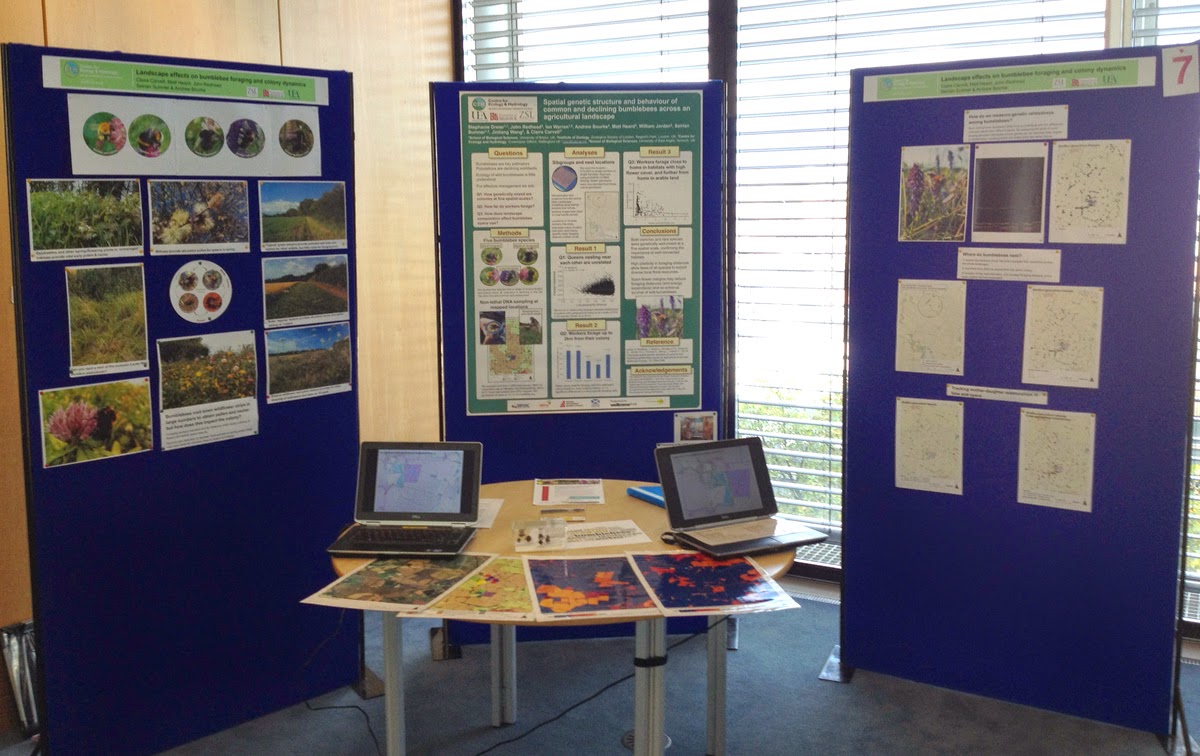
Claire Carvell, Matt Heard and John Redhead of CEH put together a stand to highlight
their research activities for the Insect Pollinators Initiative

The IPI, which ran from late 2010, funded a number of research projects investigating the causes and consequences of insect pollinator decline.

To date, the IPI projects have produced more than 40 new research papers.


Dr Adam Vanbergen of the Centre for Ecology & Hydrology (CEH) was scientific coordinator of the IPI and spoke at the dissemination event.


CEH's Dr Claire Carvell led an IPI-funded project to investigate how habitat structure affected queen and worker bumblebees in the field, collaborating with CEH colleagues and researchers from UEA, the Zoological Society of London and Bristol University.

Scientists from CEH also collaborated on a project led by the University of Leeds, “Linking agriculture and land use change to pollinator populations”. The following tweets give a flavour of some of the results produced from the research.


Defra Chief Scientist Ian Boyd was among those at the event.


The National Pollinator Strategy will be launched this Autumn.

* The Insect Pollinators Initiative was launched in 2010 and funded nine research projects worth up to £10million. It was a joint initiative from BBSRC, Defra, NERC, the Scottish Government and the Wellcome Trust, and was funded under the auspices of the Living With Environmental Change partnership.

Related CEH news stories


Queen bumblebees disperse far from their birthplace before setting up home, DNA analysis reveals 

Ecologists get first bumblebees' eye view of the landscape

Cocktail of multiple pressures combine to threaten the world’s pollinating insects

Thursday, 25 September 2014

What emission profiles aid remaining below two degrees of global warming?

In recent days multiple marches have taken place around the world, timed to coincide with the UN Climate Change summit in New York (23 September 2014). The many protestors have urged more action by governments to reduce greenhouse gas emissions.

CEH climate modeller Dr Chris Huntingford commented:

“There is still significant debate as to what constitutes safe levels of global warming. This almost certainly depends on the different impacts which can result from varying levels of warming. For example, meteorological changes affecting crop productivity detrimentally could be produced by a different level of climate change to that causing unwelcome sea-level rise. Yet despite this, the 2009 climate conference in Copenhagen pushed for the single threshold of no more than two degrees of global warming. There is a persuasive argument that this was a major achievement, as a single easy to understand temperature threshold will probably gain more traction in policymaker circles than debating a range of possible climatic futures.

The immediate question then became: “What emissions profiles can keep us below two degrees of global warming?” Working with colleagues from Met Office Hadley Centre, University of Oxford, Manchester Metropolitan University and the Committee on Climate Change, we carried out a study using a relatively simple coupled climate-carbon cycle model, but one capturing uncertainty based on differences between the fully complex climate models, as operated by various research centres across the world. The resultant paper provided “look-up” diagrams, where different emissions levels of years 2020 and 2050 can be related to the probability of remaining below two degrees. The paper also linked these 2020 and 2050 levels to both year of maximum emissions and required year-on-year emission cuts for the decades thereafter, in order to fulfil them.

The paper was published in 2012 in the journal Environmental Research Letters, but its message still stands. Namely that to have a reasonable chance of constraining warming to two degrees then emissions need to peak in the next few years, followed by year-on-year cuts of at least 3%.”

Chris Huntingford

UN Secretary General Ban Ki-Moon (front row, second from right) at the People's Climate
March in New York, held ahead of the Climate Summit he hosted at UN headquarters in
September 2014. Photo: UN / Mark Garten

Additional information


The paper can be read on the Environmental Research Letters website. It is "open access" allowing circulation of the document, and can be found here (doi: 10.1088/1748-9326/7/1/014039).

Chris Huntingford is a climate researcher at the UK Centre for Ecology & Hydrology, and also long-term visiting scientist at the Oxford University Centre for the Environment.

Information on the UN Climate Summit 2014

Monday, 14 April 2014

The Moor House Archive

In a new guest post, Steve Prince, CEH's Head of Library and Archives explains how the Moor House ecological research archive came to be maintained by CEH.

The Moor House area of Upper Teesdale in England was one of Britain’s first National Nature Reserves (NNR), designated in 1952, although its potential as a research area was already apparent through the work of scientists such as Jim Cragg and Gordon Manley. In the early 1950s William Pearsall and Verona Conway of the Nature Conservancy oversaw the purchase of the Moor House Shooting Lodge in order to establish a field station where research into ecological relationships in a mountain and moorland ecosystem could be undertaken.

There were many Nature Conservancy research stations; sadly most are now closed, as the Moor House station was in 1982. But few retained the affection of the researchers who worked there like Moor House did, to the extent that, in 2003, English Nature (now Natural England, operators of the Reserve) hosted a 50th anniversary dinner for researchers. In 2013 there was a 60th anniversary meeting at the site.

Moor House was in the first group of National Nature Reserves when it was
designated in 1952. The Nature Conservancy soon after established a field station
at the site.


The site was supported from the Nature Conservancy’s research station at Merlewood, though Nature Conservancy staff were the minority of researchers working at Moor House – most were University-based, particularly at Durham. (The research station at Merlewood then became part of the Institute of Terrestrial Ecology in the early 1970s after the Nature Conservancy was reorganised.) It is the careers of such researchers that took the name of Moor House around the scientific world.

One major project based at Moor House was the UK contribution to the International Biological Programme (IBP) which ran from 1957 to 1974, looking at ecological productivity and ecosystem function. The level of research decreased after the Programme ended, although the work of monitoring at Moor House picked up again with the creation of the Environmental Change Network in 1993 (indeed much of the work since 1993 is accessible through the ECN website).  Incidentally, ECN's long-term monitoring and data will be featured at a special symposium in Lancaster in May 2014. *

Staff from another research organisation, the Freshwater Biological Association, also worked at Moor House as the site integrated an independent freshwater reserve. In 1989 much of the FBA work transferred to the newly-established Institute for Freshwater Ecology (IFE) at Windermere. In 1994 both the IFE and the ITE (Institute of Terrestrial Ecology) were linked under the Centre for Ecology & Hydrology banner, thus strengthening CEH's ties with Moor House.

Moor House is England's highest and largest terrestrial National Nature Reserve.
The site is part of the Environmental Change Network, coordinated by CEH.


The Moor House Archive is now maintained by CEH at Lancaster. Recently, attempts have been made to make earlier science outputs more accessible, in addition to what was already available. From 1960 through to 1984 an annual report, containing research updates and meteorological reports, was produced and these have been digitized. In addition, an occasional series of 13 reports were issued and these too have been digitized. Full text copies can be downloaded from the NERC Open Research Archive (NORA). Click on the ‘Search’ tab and simply type ‘Moor House’ into the title field.

The final volume of the occasional reports series was a bibliography1, compiled in 1990, of papers and other works which used Moor House data. Due to the fact that a lot of the work at Moor House was supported by Nature Conservancy and later ITE and IFE centres, CEH Library & Archives hold many of the staff reprints and copies of the journals containing the papers.

In the last year attempts to obtain copies of those papers not previously held have been largely successful. With the exception of the dissertations listed, CEH Archive holds more than 95% of the papers listed and these can be consulted at CEH Archives in Lancaster.

For more information on Moor House material, contact:

Claire Wood and Rob Rose (Moor House Archive), or Steve Prince (CEH Library & Archives)

Steve Prince

Gill, J.P. 1990 A guide to the Moor House collection, Nature Conservancy, 62pp (Aspects of the ecology of the northern Pennines, Moor House Occasional Papers, no 13)

Additional information


Environmental Change Network: Moor House

* To celebrate 20 years of terrestrial monitoring at ECN, a symposium will take place at CEH's Lancaster site in May 2014. Further information and registration details are available from the ECN website.

Friday, 11 April 2014

New iRecord Butterflies app available

The iRecord Butterflies app is available
for iOS and Android
Updated 13 April 2014

It's been a big week for butterflies. As reported on this blog on Wednesday the UK Butterfly Monitoring Scheme 2013 data was released a few days ago. Today the new iRecord Butterflies app is available from iTunes and the Google store.

The new app, which is free to download, guides you through the identification of any butterfly that you see in the UK. You can compare your own photo with those from the app’s extensive image library, filter species by colour, pattern and size, and see distribution maps and identification tips for each butterfly species.

I've been testing the app over the last few weeks (my most recent record a Small tortoiseshell spotted in the lane next to work on Wednesday...see the photo evidence below) and can confirm it's very easy to use. It's a fantastic addition to the iRecord app range which includes Ladybirds (launched last year) and the forthcoming Orthoptera (Grasshoppers and Crickets) app.

The main advantage of the iRecord apps over other similar products is that it provides a direct way of submitting data to the national butterfly recording schemes run by Butterfly Conservation, the Centre for Ecology & Hydrology and the British Trust for Ornithology.

Every record you make with the app will help provide, in the words of Richard Fox of Butterfly Conservation, "The essential foundation for much-needed conservation work to help the UK’s declining butterflies."

Small Tortoiseshell sighting added to the iRecord Butterflies app

Many people have had a hand in the app's development including staff at Butterfly Conservation, scientists working within the Biological Records Centre (BRC) at the Centre for Ecology & Hydrology (CEH), and the developer team at Nature Locator and Natural Apptitude. CEH provided funding for the project and have linked it to the iRecord system for sharing wildlife observations, developed by Biodiverse IT and the BRC.

Tomorrow is the weekend and it's forecast to be sunny in many areas of the UK, fantastic conditions for recording butterflies. Download iRecord butterflies now and give it a try!

Barnaby Smith

Update 1 - 13 April 2014

It's 6pm at the end of the first weekend since the iRecord Butterlies app went on general release. I've just glanced at the Butterfly App Info Centre on the iRecord website. In just over 48 hours 774 records of 20 species have been submitted and numbers are increasing every time I check. Great work by all of you who've been out recording over the last two days. 80 photos have accompanied these sightings.

However...team 'Butterfly' still have some way to go to get past the Ladybird recorders. Since the iRecord Ladybirds App was launched last year 6720 records of 31 species have been submitted, plus a fantastic total of 5013 photos (approximately 3 photos for every 4 records). More details are on the Ladybird App Info Centre.

One preliminary conclusion? It may be easier to photograph a ladybird than a butterfly!

Good luck with your recording!


Additional information


The new iRecord Butterflies app is available from iTunes and the Google store

Butterfly Conservation - Butterfly recording gets smart

iRecord website

Biological Records Centre at CEH

Friday, 20 December 2013

The top 10 most viewed CEH news & blog posts of 2013

We hope you've found our content interesting and informative throughout the year but, of course, not everything will be to everyone's tastes. Here is a little (slightly unscientific!) insight into what news and blogs you were reading the most in 2013, in traditional reverse order:

Top 10 most viewed news stories


10. Distinctly autumnal feel to May as below average temperatures persist
The cold spring was still hanging around, but a warm summer wasn't too far away.

9. Ecologists get first bumblebees' eye view of the landscape
Scientists produced the most detailed picture yet of how bumblebees use the landscape, thanks to DNA technology and remote sensing.

8. Introducing the Hydrological Outlook
CEH and a number of partners had been working for a while on developing a long-range hydrological forecast for the UK.

7. Cocktail of multiple pressures combine to threaten the world's pollinating insects
Not one cause, but a combination of pressures including pesticides, disease and loss of food resources are threatening insect pollinators such as bumblebees and honeybees.

6. Are tropical forests resilient to global warming?
Tropical forests are less likely to lose biomass in response to greenhouse gas emissions over the 21st century than may previously have been thought.

5. Britain's rarest freshwater fish, the Vendace, reappears in Bassenthwaite Lake
The vendace made an unexpected reappearance in Bassenthwaite Lake in north-west England, more than a decade after being declared 'locally extinct'.

4. Tropical rainforests, 'lungs of the planet', reveal true sensitivity to global warming
The amount of carbon dioxide absorbed or produced by tropical rainforests varies hugely with year-to-year variations in the climate, revealing their vulnerability to climate change.

3. Smarter use of nutrients can help protect human health and the environment
A new report highlighted how humans have massively altered the natural flows of nitrogen, phosphorus and other nutrients, and how better management can help protect the environment, climate and human health.

2. Puffin count on Isle of May NNR gives surprising result
Despite severe spring weather, the worst fears for puffins weren't realised: a census revealed that Atlantic puffin numbers on the Isle of May National Nature Reserve off Scotland's east coast were at similar levels to 2009.

1. Mobile phone app to help monitor UK's native ladybirds after foreign invasion
iRecord Ladybirds, a free mobile phone app, was launched to help the public record ladybird species, including the invasive Harlequin ladybirds. All interest in the app, and a fantastic number of records, have been gratefully received by our scientists!

Top 10 most viewed blog posts


10.  INTECOL news round-up: pollinators, citizen science and land use
A number of CEH staff presented at the 11th INTECOL Congress in London, the world's largest international ecology meeting, and this post tried to highlight what they said.

9. Cleaner air for all - searching for solutions to air pollution at Green Week 2013
Air quality was the theme for this year's event in Brussels, and CEH expertise was on hand to lead and join in with some of the discussions.

8. We're going on a Bug Hunt!
Science can be fun too, as ecologists and pupils taking part in a hugely successful Bug Day at a school near Rugby can confirm.

7. Filming at CEH's met site in Wallingford
Wet weather at the end of 2012 and into 2013 meant a busy start to the year for the CEH Press Office, with several media requests to interview our hydrologists.

6. Building environmental links in Beijing
Environmental researchers in China and the UK have signed a memorandum of understanding to explore collaboration opportunities. Recovery of polluted environments, water management, food security and soil management were all discussed during a meeting in April.

5. Biodiversity offsetting - the science behind the policy
More information on how CEH provides independent and impartial scientific advice for the tricky topic of biodiversity offsetting.

4. Nitrogen narratives in Nairobi - confessions of a reluctant blogger
Professor Mark Sutton experiences life at the sharp end of the science-policy debate.

3. A revolution in ladybird recording
Ladybirds are charismatic insects and so it isn't surprising that people in Britain have been enthusiastically recording them for centuries.

2. Assessing the 2013 Atlantic Puffin wreck
Our two most viewed blog posts of the year are actually on the same topic, indicating the huge interest at the time, and some of the uncertainty, around a puffin wreck in Eastern Scotland and NE England.

1. Puffin wreck in Scotland
Multiple unusual deaths of puffins were noticed on the east coast of Scotland NE England in the last week of March. One of the world's foremost authorities on puffin, Professor Mike Harris, gave insights into the emerging story.

You can read more about CEH research and news over the past twelve months in our annual review of the year on the CEH News Centre. Just a final thanks to all our contributors and, of course, to our readers. More to come in 2014 but in the meantime, Happy Christmas and best wishes for the New Year!

Paulette Burns and Barnaby Smith

Friday, 15 November 2013

Integration and reflection - paperblog 8

This week we concentrate on recent papers with CEH scientists as the first author.

PhD student Philip Martin recently published a major paper summarising his research over the last few years. You can read more about "Carbon pools recover more quickly than plant biodiversity in tropical secondary forests" (published in Proceedings of the Royal Society B) on the CEH website and on Philip's blog.

Another PhD student, Christopher Malley, has a new paper out in Atmospheric Research which takes a detailed look at how well two of the UK's atmospheric monitoring 'supersites', including the site run by CEH at Auchencorth Moss in Scotland, represent the UK's background ozone conditions.

CEH is a Centre that carries out both ecological and hydrological science, sometimes together (the clue is in the name!). Our scientists produce many papers that seek to bring together varied data on water quantity, freshwater ecology, and water quality. In recent weeks, CEH scientists have published on estimating concentrations in rivers of different chemicals originating from sewage treatment plants (Keller et al., open access in Environmental Toxicology and Chemistry), and a new approach for predicting phosphorus concentrations in rivers (Greene et al., Journal of Hydrology).

Sometimes it is necessary to take a step back from day to day research to ponder some fundamental questions on how scientific knowledge can be used in wider society. Two examples have recently appeared. Alan Gray has a new paper in Transgenic Research examining whether applied ecology has failed the transgenic crops debate. Stefan Reis and colleagues from CEH, Universities and Health Institutes across the UK have put together a new analysis on how to integrate health and environmental impact analysis to address some of the new public health challenges.

Nitrogen science plays a big role in CEH activities. Laurence Jones and CEH colleagues have produced a new review of the evidence for nitrogen impacts on ecosystem services. Read it in the journal Ecosystem Services, where the paper is open access (full text freely available). Meanwhile, Mark Sutton is lead author on another new open access paper in Environmental Development looking at "Green Economy thinking" and relevance to control of nitrous oxide emissions.

Finally, Robert Mills, who completed a PhD at CEH's site in Bangor, North Wales, has just published a new paper on organic carbon turnover rates in natural and semi-natural topsoils. Working with Professor Ed Tipping, the study concludes with the interesting result that turnover is faster under trees than non-trees. Read more in the journal Biogeochemistry.

That's it. As ever, we welcome suggestions and comments on the material presented in the paperblog. Let us know what you think!

Barnaby Smith, Media Relations Manager

Additional information


If you'd like a fuller picture of new papers from CEH, just follow the CEH Paper Alerts Twitter feed, which lists CEH peer-reviewed papers newly published online. Full details of Centre for Ecology & Hydrology science publications, including those published in peer-reviewed science journals, are eventually catalogued on the NERC Open Research Archive (NORA).

Those of you who follow the scientific literature will know some journal websites require registration and some are subscription-only. CEH, as part of NERC, is working with publishers and funders to make more of our output open access, and we have indicated above where this is the case.

We also publish lots of our other outputs including biological records atlases and project reports. More details can be found in the publications section of the CEH website.

Wednesday, 25 September 2013

Cormorant-fishery conflicts: photos from the INTERCAFE project

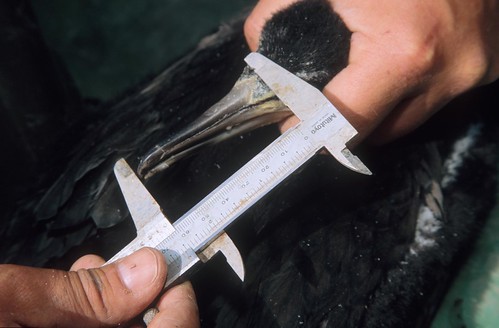
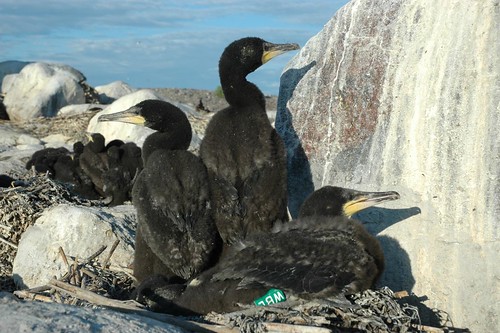
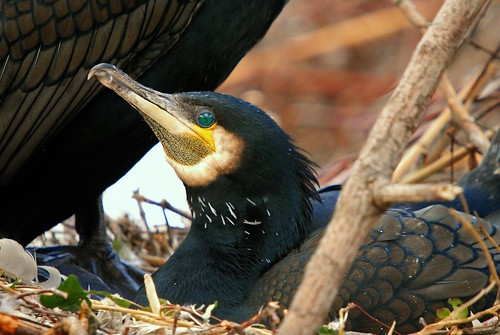
Findings from a major Europe-wide study into cormorant-fishery conflicts have been published, providing one of the most detailed ecological and socio-economic investigations of these fish-eating birds, their impacts and implications for their management. Read more in CEH news and view photos from the project below.

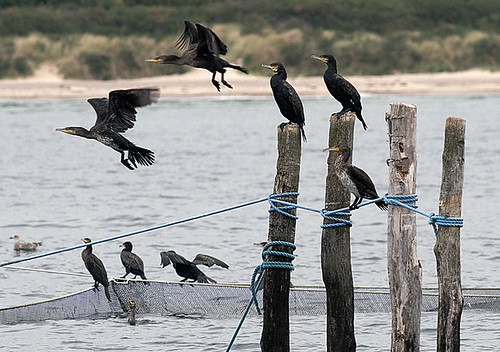
The INTERCAFE study, chaired by David Carss of CEH, included the first
pan-European census of the number and distribution of cormorants in summer
and wintertime. Cormorant numbers across Europe have been increasing,
particularly within the last three decades.
Photo: INTERCAFE
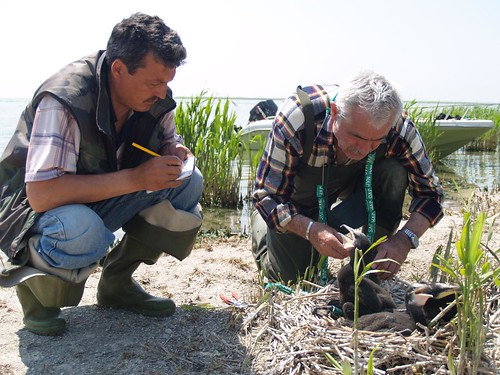
Researchers carry out an INTERCAFE field survey (c) INTERCAFE. The
INTERCAFE reports include an overview of field techniques and standard
research methods for cormorants, fishes and the interactions between them.
Photo: INTERCAFE

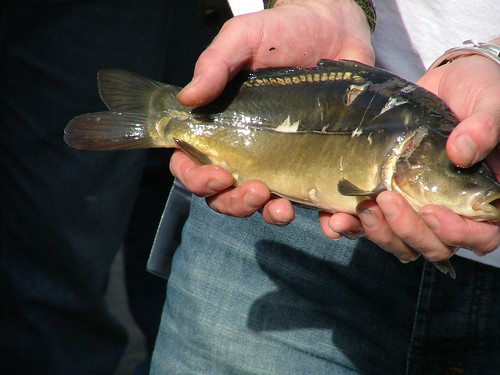
A carp damaged by a cormorant. The INTERCAFE reports contain analysis
of cormorant-fisheries conflicts at carp-rearing ponds - an important freshwater
fishery sector across continental Europe - where problems at individual sites
can be caused by birds which breed as far as 2000km away.
Photo by Robert Gwiazda
The project drew together researchers from a number of disciplines, including
bird-related and broader ecology disciplines, fisheries science and management,
sociology, social anthropology and international law, together with experts on
fisheries production, harvest and management, local interest groups and
international policy-makers.
Photo: INTERCAFE
The project involved 70 researchers from 30 countries, as well as hundreds
of volunteers of the Wetlands International-IUCN Cormorant Research Group.
Photo by Stef van Rijn.
Photo of a cormorant by Josef Trauttmansdorff


More information


CEH News: Europe-wide studies into cormorant-fishery conflicts published

INTERCAFE reports

Flickr set of photos from INTERCAFE project

Wednesday, 18 September 2013

Freshwater Ecology Group's loch health research highlighted

Scientific research carried out by CEH's Freshwater Ecology Group has been highlighted in an article published recently in the popular magazine Scotland Outdoors. The article, in the Autumn 2013 edition, describes how research by the group has shaped the methods by which the health of Scotland's lochs are measured and how this work has shown that Scotland has some of the cleanest and healthiest freshwaters in Europe.

Swan on Loch Leven (photo by Laurence Carvalho)

The article showcases a variety of work by members of the Edinburgh-based Group, including long-term work at CEH's flagship monitoring site at Loch Leven, ecosystem restoration work carried out at Loch Flemington, and a large-scale survey of more than 200 lochs carried out to assess the health of our most important sites of conservation interest.

Sustaining the quality of freshwaters is vital to Scotland's economy and this article highlights how the Group's research is vital to maintaining and raising the standards of this precious resource, providing responses to threats and enhancing the benefits that freshwaters bring to society.

Laurence Carvalho

Related links


Scotland Outdoors magazine (subscription required)

Loch Leven monitoring

CEH's UK lake restoration research

Staff page of Dr Laurence Carvalho

Friday, 30 August 2013

Hedgerows and hydrology - CEH paperblog 5

Our latest paperblog highlights some of the recently published scientific papers led by or involving researchers from the Centre for Ecology & Hydrology.

  • A new study in Global Change Biology describes results from a nine-year N perturbation, manipulation experiment carried out by CEH scientists on an ombrotrophic bog, Whim (a site in the Scottish Borders). Ammonium and nitrate were provided in rainwater spray in differing amounts, plus a rainwater only control, via an automated system coupled to site meteorology. The work was led by Dr Lucy Sheppard.

  • A study recently published in Biological Conservation examined changes over 70 years in hedgerow floral diversity, including the impacts of management. The paper, led by CEH's Jo Staley with colleagues James  Bullock, John Redhead, Danny Hooftman and Richard Pywell, used a unique botanical dataset for 357 hedge sites across a study area of 2600 km2 in Dorset, collected in the 1930s and again in 2001. 


  • Professor Mike Acreman of CEH and Profesor Joe Holden from the University of Leeds have published a new article on "How Wetlands Affect Floods". It was published in Wetlands, the official scholarly journal of the Society of Wetland Scientists, in mid-August. They focused on two example wetland types (upland rain-fed wetlands and floodplain wetlands) to demonstrate why there are differences in flood functions both within and between wetland types.

Open access publishing is increasingly becoming the 'norm' in scientific publishing in the UK. To end this month's paperblog, we highlight three papers, all open access, which involve CEH scientists.


Barnaby Smith - Media Relations Manager

Additional information


If you'd like a fuller picture of new papers from CEH, just follow the CEH Paper Alerts Twitter feed, which lists CEH peer-reviewed papers newly published online. Full details of Centre for Ecology & Hydrology science publications, including those published in peer-reviewed science journals, are eventually catalogued on the NERC Open Research Archive (NORA).

Those of you who follow the scientific literature will know some journal websites require registration and some are subscription-only. CEH, as part of NERC, is working with publishers and funders to make more of our output open access, and we have indicated above where this is the case.

We also publish lots of our other outputs including biological records atlases and project reports. More details can be found in the publications section of the CEH website.

Monday, 12 August 2013

Habitat quality, borehole insights & lake studies - CEH paperblog 4

Our latest paperblog highlights some of the recently published scientific papers led by or involving researchers from the Centre for Ecology & Hydrology.

  • A study in Agriculture, Ecosystems & Environment examined relationships between habitat and breeding success for two of our common bird species, the great tit Parus major and the blue tit Cyanistes caeruleus. The aim was to determine the potential of these species to act as indicators of food resource availability for birds in managed semi-natural habitats on farmland, thus acting as a measure of the effectiveness of specific management practices under agri-environment schemes. The paper, led by CEH's John Redhead with colleagues Richard Pywell, Richard Broughton and Shelley Hinsley, followed a four-year study of breeding success using 90 nestboxes on arable farmland in central England. Researchers from the RSPB and Bournemouth University also collaborated on the study, which found that habitat within 100m of the nestbox was the most influential on breeding success.
  • Dr Chris Huntingford of CEH led a recent study published in the journal Nature, with colleagues from the University of East Anglia and the University of Exeter, which examined shifting patterns of temperature volatility in the climate system. The findings contradicted the sometimes stated view that a warming world will automatically be one of more overall climatic variation. Read CEH's press release and the Nature paper itself.
  • CEH scientists often collaborate with our NERC colleagues on particular projects and areas of research. A new paper in PLOS One led by British Geological Survey colleagues is a recent example, in which hydrogeology is used to tackle questions in groundwater ecology. In the study, the team used borehole imaging and invertebrate sampling to shed more light on groundwater ecosystems and their potential ecosystem services. (The paper is open access).
  • The Isle of May in the Firth of Forth is the location for one of CEH's most important monitoring projects, a long-term seabird ecology study. Puffins perhaps get the most column inches in coverage of this internationally recognised work, but several species of seabirds are actually monitored on the island. One such species is the European shag (Phalacrocorax aristotelis), and a new paper in Ibis reveals more about the dispersal rates and distances of shags colour-ringed as chicks on the Isle of May. The paper led by PhD student Emily Barlow represents a collaboration between CEH and the University of Aberdeen.
  • The discharge of pharmaceuticals into the aquatic environment from wastewater is a topical area of discussion for researchers, regulators and the water industry. Professor Andrew Johnson has led a new study evaluating the potential environmental concentrations of four drugs from a group often featured on lists of pharmaceuticals of concern that are discharged into our river systems - the results showed considerable variation in the popularity of the drugs across Europe, with such variations potentially having an effect on the detection of these compounds in sewage effluent or river water. Radboud University and Brunel University scientists collaborated on the paper in Environmental Toxicology and Chemistry.
  • Finally for this edition, Dr Bryan Spears from CEH has led an international team of researchers, including from Wageningen in the Netherlands, the Institute Dr Nowak in Germany and New Zealand's National Institute of Water & Atmospheric Research in a eutrophication management study. The team looked at the potential for negative ecological impacts following the use of a lanthanum-modified bentonite clay to control phosphorus release from lake bed sediments. The study, published in Water Research, examined 16 case study lakes and the findings have implications for water managers worldwide.

Paulette Burns - Media Coordinator

Additional information


If you'd like a fuller picture of new papers from CEH, just follow the CEH Paper Alerts Twitter feed, which lists CEH peer-reviewed papers newly published online. Full details of Centre for Ecology & Hydrology science publications, including those published in peer-reviewed science journals, are eventually catalogued on the NERC Open Research Archive (NORA).

Those of you who follow the scientific literature will know some journal websites require registration and some are subscription-only. CEH, as part of NERC, is working with publishers and funders to make more of our output open access, and we have indicated above where this is the case.

We also publish lots of our other outputs including biological records atlases and project reports. More details can be found in the publications section of the CEH website.

Wednesday, 24 July 2013

Feeding, fisheries and food webs - CEH paperblog 3

Our third paperblog covers cormorants, insect herbivores, England's largest lake, natural capital and water chemistry. (For those who want to know more about our paperblog concept, take a look at paperblog #1 published on 21 June).

CEH PhD student Scott McKenzie has a new paper in the Royal Society's Biology Letters, showing how two insect herbivores, an above-ground aphid and a below-ground vine weevil, may benefit in the presence of one another. According to the publishers, "This is known as feeding facilitation and is rare in nature." Read more in the paper, "Reciprocal feeding facilitation between above- and below-ground herbivores".

Dr Chris Huntingford and Dr Lindsay Banin were co-authors on two of the papers in the recent special issue of Philosophical Transactions of the Royal Society B which looked at change in African rainforests, past, present and future. Many of the papers in the issue are open access.

CEH's lake ecology scientists have published a paper in Global Change Biology on food web de-synchronisation in England's largest lake, Windermere. Read the paper here.

Professor Rosie Hails, CEH's Science Director for Biodiversity and Ecosystem Science, worked with Professor Steve Ormerod of Cardiff University on an editorial for the Journal of Applied Ecology. The editorial, "Ecological science for ecosystem services and the stewardship of Natural Capital", introduced five papers in a Special Profile showing how ecologists in the UK are contributing nationally and internationally to these issues, stemming from the UK National Ecosystem Assessment - the first ever national scale exercise of its type in the world.

Dr Steven Cole of CEH and colleagues from NERC's British Geological Survey have published a new paper in the Journal of Hydrology. The paper uses a novel application of CEH's G2G model combined with geochemical sampling to understand macronutrient fluxes across a catchment.

Staying with catchment water chemistry, CEH Fellow Professor Colin Neal and long-time collaborator Professor Jim Kirchner have published a summary of their work on universal fractal scaling in stream chemistry and its implications for solute transport and water quality trend detection. It can be found in PNAS.

And finally, in the next few months the final outputs from the EU-funded Intercafe project - which aimed to improve European scientific knowledge of cormorant-fisheries interactions - will be made available. Dr David Carss, who led the Intercafe project, has a lead-author paper, "Managing European cormorant-fisheries conflicts: problems, practicalities and policy" in the journal Fisheries Management and Ecology which previews some of the work.

As always, we're very interested in your feedback, so please let us know what you think, and any improvements that could be made, by commenting on the blog or emailing us via enquiries@ceh.ac.uk.

That's it for now, more in a couple of weeks!

Barnaby Smith - CEH Media Relations Manager

Additional information


If you'd like a fuller picture of new papers from CEH, just follow the @CEHPaperAlerts Twitter feed, which lists CEH peer-reviewed papers newly published online. Full details of Centre for Ecology & Hydrology science publications, including those published in peer-reviewed science journals, are eventually catalogued on the NERC Open Research Archive (NORA).

Those of you who follow the scientific literature will know some journal websites require registration and some are subscription-only. CEH, as part of NERC, is working with publishers and funders to make more of our output open access, and we'll be indicating where this is the case.

We also publish lots of other outputs including biological records atlases and project reports. More details can be found on the publications page of our website.

Friday, 5 July 2013

Peat, puffins and pollinators - Paperblog No 2

Our second paperblog covers wildlife and radionuclides, peatland chemistry, puffin survival, drugs and the environment, and pesticides and rats. For those who want to know more about the paperblog concept, take a look at paperblog #1 published on 21 June.

  • Dr Nick Beresford and colleagues from Canada, Austria, Sweden and Finland have produced "A new approach to predicting environmental transfer of radionuclides to wildlife". Their new paper in Science of the Total Environment applies the method to freshwater fish and caesium.
  • Dr Lucy Sheppard and colleagues from the Netherlands and Spain report on a nine-year experiment examining vegetation changes and chemistry in a Scottish peatland. The paper is published in Biogeochemistry.
  • Prof Mike Harris and scientists from CEH's seabird ecology team working on the Isle of May NNR off the east coast of Scotland have used geolocators attached to Atlantic puffins to gain further insights into their survival rates over winter. The paper is published in Marine Biology.
  • Prof Richard Shore, who studies the exposure and effects of pollutants, biocides and pesticides in wild birds and mammals, is a co-author on a new paper in Biology Letters. It reports the conclusions of a Royal Society-supported seminar involving experts from diverse scientific fields discussing the risks posed by pharmaceuticals to wildlife.
  • Prof Shore, along with three CEH colleagues, also co-authors a new paper in Food and Chemical Toxicology which examines metabolic and physiological changes in rats following short-term oral dosing with pesticides commonly found in food.
  • And finally a special mention for the new publication from the British Ecological Society, "100 Influential Papers", which were chosen from BES journals published in the society's first 100 years. Research by several current and former CEH scientists is included, as well as several papers published by staff at our predecessor institutes. One of the more recent papers included in the list is a study led by Dr Claire Carvell comparing the efficacy of agri-environment schemes to enhance bumblebee abundance and diversity on arable field margins. The study, published in 2006, "represents a quantum shift in our approach", in the words of Prof Jane Memmott, who recommended it for inclusion on the 100 influential papers list.
That's it for our second paperblog. More in a couple of weeks!

Barnaby Smith - CEH Media Relations Manager

Additional information


If you'd like a fuller picture of new papers from CEH, just follow the @CEHPaperAlerts Twitter feed, which lists CEH peer-reviewed papers newly published online. Full details of Centre for Ecology & Hydrology science publications, including those published in peer-reviewed science journals, are eventually catalogued on the NERC Open Research Archive (NORA).

Those of you who follow the scientific literature will know some journal websites require registration and some are subscription-only. CEH, as part of NERC, is working with publishers and funders to make more of our output open access, and we'll be indicating where this is the case.

We also publish lots of other outputs including biological record atlases and project reports. More details can be found in the publications section of the CEH website.

As always, we're very interested in your feedback, so please let us know what you think or suggest any improvements that could be made by commenting on the blog or emailing us via enquiries@ceh.ac.uk

Wednesday, 26 June 2013

Crowd-sourced soil data for Europe; and the Globe?

CEH scientists worked with our NERC colleagues in the British Geological Survey on the development of the mySoil app, which was released for iOS in June 2012 and has since gained more than 12,000 users. The developers are now hoping to expand it further:

mySoil is a free smartphone app (downloadable at the iTunes App Store), originally for the United Kingdom and recently expanded to cover Europe with contributions from the Met Office in the UK and the Joint Research Centre, Italy. mySoil contains a soil properties map with basic information on soil texture, pH and vegetation habitat. It also has the ability to crowd source geo-referenced data. We are continuing to expand the capabilities of mySoil and would be interested in hearing from groups who might help with data to take this effort global.

David A Robinson.

Friday, 21 June 2013

Introducing the CEH 'paperblog'

CEH scientists lead or co-author more than 400 peer-reviewed papers every year in a wide variety of journals. We know that many of you are interested in regular updates on recent papers involving our scientists, so we’re introducing a new regular ‘paperblog’. The intention is to publish a short post every other Friday giving details and links to a selection of interesting research published in the last few weeks. I’ll try to include four or five recent papers, most of which will have a CEH scientist as lead author, although I’ve reserved the right to make exceptions for interesting material our staff have co-authored.

Paperblog No 1 - 21 June 2013


A bumper edition to launch the paperblog covering topics such as Scottish mountain ecology, ecosystem services, evaporation in Britain, health effects of drought, gannets, river pollution, ecological networks and nitrogen deposition.

  • Dr Alison Kay, working with CEH colleagues, wrote "A hydrological perspective on evaporation: historical trends and future projections in Britain". The paper is published in Journal of Water and Climate Change and the abstract can be read here.
  • Dr Christel Prudhomme worked with staff at the Health Protection Agency (now Public Health England) on a systematic review of the health effects of drought. It’s Open Access and published in PLOS Currents.
  • Dr Dan Chapman has a new paper in Global Change Biology reporting on his study using MODIS satellite data to look at temperature sensitivity of mountain vegetation activity on over 2700 Scottish mountain peaks.
  • Monika Jurgens and CEH colleagues worked with scientists from Lancaster University to publish a new paper in Science of the Total Environment looking at the presence of mercury and other substances in wild fish. The paper abstract is here and the paper has already been covered by the Chemical Watch news website (registration required).

That’s it for our first paperblog. More in a couple of weeks!

Barnaby Smith – CEH Media Relations Manager

Additional information


If you’d like a fuller picture of new papers from CEH, just follow the @CEHPaperAlerts twitter feed, which lists CEH peer-reviewed papers newly published online. Full details of Centre for Ecology & Hydrology science publications including those published in peer-reviewed science journals are eventually catalogued on the NERC Open Research Archive (NORA).

Those of you that follow the scientific literature will know some journal websites require registration and some are subscription-only. CEH, as part of NERC, is working with publishers and funders to make more of our output open access, and we’ll be indicating where this is the case.

We also publish lots of other outputs including biological records atlases and project reports. More details can be found on the publications page of our website.

As always we’re very interested in your feedback, so please let us know what you think and any improvements that could be made by commenting on the blog or emailing us via enquiries@ceh.ac.uk.

Thursday, 13 June 2013

A day out on the farm - collecting scientific data during Open Farm Sunday

Staff and students from the Centre for Ecology & Hydrology (CEH) were heavily involved with the second national farm pollinator survey on 9 June 2013, which took place as part of Open Farm Sunday. Kate Titford, a student spending the summer at CEH, describes the role she played on the day and reflects on the role members of the public can play in collecting scientific data.
You don’t have to be a professional scientist to contribute to science these days. With recent reports of declines in many species across the country everyone can play their part in monitoring changes. Sunday 9 June saw the second annual pollinator surveys taking place on farms across the UK as part of Open Farm Sunday. Scientists and volunteers from the Centre for Ecology & Hydrology (CEH) helped members of the public to count pollinators buzzing around crops, pasture and field margins rich with wild flowers.
I joined the team at Waddesdon Estate, Buckinghamshire, commandeering visitors queuing for the tractor trailer rides to take part in a survey. After a cool, cloudy start to the day the sun appeared and brought out the crowds and the insects, too. Our budding scientists ranged from little children, keen to see insects in action after learning about them at school, to mums waiting for children to return from the trailer rides and interested in discovering more about these vital creatures. On our farm we mostly surveyed grass fields and pasture, and their flowering margins whilst other farms surveyed crops as well.

Examining a farmland field margin at Waddesdon Manor during the farm
pollinator survey held during Open Farm Sunday. Photo: Heather Lowther


Tiny parasitic wasps intrigued lots of our citizen scientists. “That’s really a wasp” and “can it sting me?” were frequent comments. Miniature micro moths and beetle larvae hiding in flowers kept children busy counting to make sure none were missed.
As essential to farms as the gigantic combine harvester sharing our field, pollinators are a key part of producing our food and so monitoring numbers will give scientists a better idea about how they are faring. Thanks to all our lovely volunteers, we managed to complete more than 30 surveys giving us valuable data to add to the records from the other farms. All the results from this year will be combined with those from last year to study any changes in the pollinators surveyed.

Younger visitors were enthusiastic contributors to the pollinator survey at
Waddesdon. Photo: Heather Lowther


So, not only did all our enthusiastic volunteers (and I) enjoy a day out at the farm, they made an important contribution to science as well. Twelve-year-old Ella, who took part in the pollinator survey at Waddesdon, said, “I really enjoyed the pollinator survey it was very interesting and we found lots of good bugs and some amazing beetle larvae! I enjoyed contributing to this science research because it is very interesting to learn about pollinators and it makes you feel good to think that your survey has contributed to real science!” 
To take part in a whole variety of surveys as a citizen scientist yourself, look at the Biological Records Centre website for more information.

Kate Titford

Kate is a student at Reading University undertaking a Masters project at CEH (using data from the UK Ladybird Survey) for the summer.

Additional information

Latest results from the Pollinator Survey from the Open Farm Sunday website
More details about the farm pollinator survey from the Open Farm Sunday website

Results from the 2012 Open Farm Sunday Pollinator Survey