
Showing posts with label climate change. Show all posts
Showing posts with label climate change. Show all posts
Wednesday, 4 February 2015
CEH Climate science referenced in US Senate
Earlier this year a climate modelling paper published in Nature in 2013 which was led by CEH scientist Dr Chris Huntingford was mentioned in a US Senate debate.
Senator James M Inhofe made reference to the research during a debate on the KXL oil pipeline. He was reported as claiming that the Huntingford Nature paper casts doubt on the reality of anthropogenic climate change.
His exact words were "Nature journal, which is a well-respected journal, in their 2013 paper said that 'there is considerable uncertainty as to whether [increases in extreme climate variability] is occurring."
Subsequent to the debate Dr Huntingford was contacted by a US journalist and asked if his research did show there is "considerable uncertainty as to whether [increases in extreme climate variability] is occurring."
Chris replied, "Our Nature paper strictly analyses only year-to-year variability (fluctuations) in temperature, and demonstrates that in some parts of the world, this is actually going down. Elsewhere it is going up. This may be seen in both direct measurements and in supporting climate model simulations. This goes against the view that maybe, as general global warming occurs, everywhere will additionally see larger year-to-year swings in temperature."
"However, we do not at any point offer evidence against a general on-going background and upwards warming trend. Detection and attribution statistical studies show that the observed average increasing temperatures are almost certainly a consequence of the burning of fossil fuels."
This quote was used verbatim here and has also been subsequently referred to in the Congressional Record (Proceedings and debates of the US Congress).
You can read more about the original paper on the CEH website here.

Friday, 12 December 2014
Potential climate change impacts: a global, multi-sectoral assessment
Recent graduate Anna Feeney is currently working at CEH, helping us to prepare content for our new website (more on that in the New Year!). Anna has been getting to know our science by reading some of the recent peer-reviewed outputs authored by CEH scientists. Here she describes one paper which caught her eye:
“A new paper recently published in the journal Climatic Change explores some future climate change scenarios, and translates projected changes in meteorological conditions into a range of different impacts that might affect the day-to-day lives of millions of people.
The work was led by Professor Nigel Arnell from the University of Reading. It uses a “pattern-scaling” technique to capture the main features of available climate models from around the world including the IMOGEN model developed by CEH’s Dr Chris Huntingford, who is also a co-author of the article. The research team used 21 climate models and four possible socio-economic tracks to examine a whole host of sectors such as water resources and agriculture.
According to the authors it is potentially one of the most multi-dimensional, wide-ranging studies into climate change impacts to date.
The four socio-economic pathways represent potential future societal habits, each taking into account possible changes in consumption patterns, socio-economic behaviour and corresponding levels of carbon emissions. After combining this information with the 21 different climate change models, changes to climate could be estimated at regional levels at three different milestones: 2020, 2050, and 2080.
Under one projection for 2050, a sea level rise of 12-32cm is projected which could lead to about 450 million people potentially struggling with increased river flooding, about 1 billion other people possibly feeling increased water stress, and each year an extra 1.3 million of those living near the coast could be flooded.
The authors conclude that a planet that is on average 2.2C warmer would mean that more energy would be consumed in cooling efforts, although that increase in consumption would be offset by reduced need for heating during the colder seasons. Of particular note is that most areas would experience a fall in crop productivity, with implications for the global food supply chain.
A striking conclusion of the report is that, for many impacts, differences between driving climate models are actually more significant than the difference between the socio-economic forcing scenarios. This is mirrored in the IPCC reports, where although all models agree on at least some level of global warming, when it comes to expected changes in rainfall patterns (a key determinant for many impacts of concern) there are large parts of the world with very little agreement. It is hoped that increased data availability will be able to narrow down predictions of global water systems and that the overall uncertainty will eventually become much smaller.
For the present at least, however, adaptation policy determining how to live with climate change will have to keep in mind the complex nature of climate models and their current uncertainties, as well as the multiple potential scenarios based on how much fossil fuel is burnt in to the future.”
Anna Feeney
The open access paper can be read online.
Full paper reference: Arnell, N. W., Brown, S., Gosling, S. N., Gottschalk, P., Hinkel, J., Huntingford, C., ... & Zelazowski, P. (2014). The impacts of climate change across the globe: A multi-sectoral assessment. Climatic Change, 1-18. doi: 10.1007/s10584-014-1281-2
Staff page of Dr Chris Huntingford, CEH
“A new paper recently published in the journal Climatic Change explores some future climate change scenarios, and translates projected changes in meteorological conditions into a range of different impacts that might affect the day-to-day lives of millions of people.
The work was led by Professor Nigel Arnell from the University of Reading. It uses a “pattern-scaling” technique to capture the main features of available climate models from around the world including the IMOGEN model developed by CEH’s Dr Chris Huntingford, who is also a co-author of the article. The research team used 21 climate models and four possible socio-economic tracks to examine a whole host of sectors such as water resources and agriculture.
According to the authors it is potentially one of the most multi-dimensional, wide-ranging studies into climate change impacts to date.
The four socio-economic pathways represent potential future societal habits, each taking into account possible changes in consumption patterns, socio-economic behaviour and corresponding levels of carbon emissions. After combining this information with the 21 different climate change models, changes to climate could be estimated at regional levels at three different milestones: 2020, 2050, and 2080.
 |
| Aerial views during an Army search and rescue mission show damage from Hurricane Sandy to the New Jersey coast, Oct. 30, 2012. US Air Force photo by Master Sgt Mark C Olsen (in public domain). |
Under one projection for 2050, a sea level rise of 12-32cm is projected which could lead to about 450 million people potentially struggling with increased river flooding, about 1 billion other people possibly feeling increased water stress, and each year an extra 1.3 million of those living near the coast could be flooded.
The authors conclude that a planet that is on average 2.2C warmer would mean that more energy would be consumed in cooling efforts, although that increase in consumption would be offset by reduced need for heating during the colder seasons. Of particular note is that most areas would experience a fall in crop productivity, with implications for the global food supply chain.
A striking conclusion of the report is that, for many impacts, differences between driving climate models are actually more significant than the difference between the socio-economic forcing scenarios. This is mirrored in the IPCC reports, where although all models agree on at least some level of global warming, when it comes to expected changes in rainfall patterns (a key determinant for many impacts of concern) there are large parts of the world with very little agreement. It is hoped that increased data availability will be able to narrow down predictions of global water systems and that the overall uncertainty will eventually become much smaller.
For the present at least, however, adaptation policy determining how to live with climate change will have to keep in mind the complex nature of climate models and their current uncertainties, as well as the multiple potential scenarios based on how much fossil fuel is burnt in to the future.”
Anna Feeney
The open access paper can be read online.
Full paper reference: Arnell, N. W., Brown, S., Gosling, S. N., Gottschalk, P., Hinkel, J., Huntingford, C., ... & Zelazowski, P. (2014). The impacts of climate change across the globe: A multi-sectoral assessment. Climatic Change, 1-18. doi: 10.1007/s10584-014-1281-2
Staff page of Dr Chris Huntingford, CEH
Monday, 6 October 2014
Solar dimming and river flows - background to new paper
A new Met Office-led paper has just been published in the journal Nature Geoscience, entitled “Detection of solar dimming and brightening effects on Northern Hemisphere river flow” by Nic Gedney et al.
Chris Huntingford, who is a co-author, writes:
“In any debate surrounding large-scale environmental change, invariably there is discussion as to the effect of increasing levels of atmospheric greenhouse gases. This is particularly in terms of temperature change, and much attention has been placed on fusing together models and data to identify whether there is a human influence on the climate system. Such analysis (often called “detection and attribution”) does suggest that to a high level of confidence, fossil fuel burning has altered the climatic state by increasing atmospheric concentrations of gases such as carbon dioxide. However these analyses of temperature measurements also confirm that an atmospheric aerosol signal is present. The raised level of such particulates, regionally at least, has a partial cooling offset of global warming. Additionally higher aerosol concentrations are known to reduce the amount of the Sun’s light and energy reaching the Earth’s surface.
In this study we accept that both raised greenhouse gas concentrations and aerosols alter meteorological conditions (via temperature levels and indirectly rainfall), which in turn will influence river flows. However to confirm the presence of any aerosol signal, here we instead focus specifically on the impact of changes in sunlight and energy reaching the land surface, and on implications for observed river flows in multiple basins in Northern Hemisphere industrialised areas. This is through the so-called “dimming” and subsequent “brightening” period, the latter a consequence of clean-air acts in many regions.
In our study, we find that when we use a river runoff model, forced with and without estimates of aerosol-induced changes in surface shortwave radiation (i.e. surface energy), then we can only fully explain the river flow data once the aerosol effect is included. Lower surface energy tends to enhance river flows to levels higher than they might otherwise have been. This is because this suppresses water loss by evaporation across the land surface. We can see this effect over Central Europe, in the periods of major solar dimming.
A major focus on climate change will always remain as characterising changes in surface temperature. However to additionally observe and explain anthropogenic influences in a key impact such as river flows does raise confidence in ability to model our changing environment. Such confidence is required, in order to then be able to rely on future computer-based projections and the role they may play in underpinning future policy on the global environment.”
The paper authors are from the Met Office, Centre for Ecology & Hydrology, University of Reading, Laboratoire de Météorologie Dynamique in France, and the University of Exeter.
Chris Huntingford is a Climate Modeller at the Centre for Ecology & Hydrology.
Air pollution increases river flows - CEH news story
Paper details:
Detection of solar dimming and brightening effects on Northern Hemisphere river flow.
Gedney, N., Huntingford, C., Weedon, G.P., Bellouin, N., Boucher, O. and Cox, P.M. (2014), Nature Geoscience, doi: 10.1038/NGEO2263
Staff page of Dr Chris Huntingford, CEH
Chris Huntingford, who is a co-author, writes:
“In any debate surrounding large-scale environmental change, invariably there is discussion as to the effect of increasing levels of atmospheric greenhouse gases. This is particularly in terms of temperature change, and much attention has been placed on fusing together models and data to identify whether there is a human influence on the climate system. Such analysis (often called “detection and attribution”) does suggest that to a high level of confidence, fossil fuel burning has altered the climatic state by increasing atmospheric concentrations of gases such as carbon dioxide. However these analyses of temperature measurements also confirm that an atmospheric aerosol signal is present. The raised level of such particulates, regionally at least, has a partial cooling offset of global warming. Additionally higher aerosol concentrations are known to reduce the amount of the Sun’s light and energy reaching the Earth’s surface.
In this study we accept that both raised greenhouse gas concentrations and aerosols alter meteorological conditions (via temperature levels and indirectly rainfall), which in turn will influence river flows. However to confirm the presence of any aerosol signal, here we instead focus specifically on the impact of changes in sunlight and energy reaching the land surface, and on implications for observed river flows in multiple basins in Northern Hemisphere industrialised areas. This is through the so-called “dimming” and subsequent “brightening” period, the latter a consequence of clean-air acts in many regions.
In our study, we find that when we use a river runoff model, forced with and without estimates of aerosol-induced changes in surface shortwave radiation (i.e. surface energy), then we can only fully explain the river flow data once the aerosol effect is included. Lower surface energy tends to enhance river flows to levels higher than they might otherwise have been. This is because this suppresses water loss by evaporation across the land surface. We can see this effect over Central Europe, in the periods of major solar dimming.
A major focus on climate change will always remain as characterising changes in surface temperature. However to additionally observe and explain anthropogenic influences in a key impact such as river flows does raise confidence in ability to model our changing environment. Such confidence is required, in order to then be able to rely on future computer-based projections and the role they may play in underpinning future policy on the global environment.”
The paper authors are from the Met Office, Centre for Ecology & Hydrology, University of Reading, Laboratoire de Météorologie Dynamique in France, and the University of Exeter.
Chris Huntingford is a Climate Modeller at the Centre for Ecology & Hydrology.
Additional information
Air pollution increases river flows - CEH news story
Paper details:
Detection of solar dimming and brightening effects on Northern Hemisphere river flow.
Gedney, N., Huntingford, C., Weedon, G.P., Bellouin, N., Boucher, O. and Cox, P.M. (2014), Nature Geoscience, doi: 10.1038/NGEO2263
Staff page of Dr Chris Huntingford, CEH
Thursday, 25 September 2014
What emission profiles aid remaining below two degrees of global warming?
In recent days multiple marches have taken place around the world, timed to coincide with the UN Climate Change summit in New York (23 September 2014). The many protestors have urged more action by governments to reduce greenhouse gas emissions.
CEH climate modeller Dr Chris Huntingford commented:
“There is still significant debate as to what constitutes safe levels of global warming. This almost certainly depends on the different impacts which can result from varying levels of warming. For example, meteorological changes affecting crop productivity detrimentally could be produced by a different level of climate change to that causing unwelcome sea-level rise. Yet despite this, the 2009 climate conference in Copenhagen pushed for the single threshold of no more than two degrees of global warming. There is a persuasive argument that this was a major achievement, as a single easy to understand temperature threshold will probably gain more traction in policymaker circles than debating a range of possible climatic futures.
The immediate question then became: “What emissions profiles can keep us below two degrees of global warming?” Working with colleagues from Met Office Hadley Centre, University of Oxford, Manchester Metropolitan University and the Committee on Climate Change, we carried out a study using a relatively simple coupled climate-carbon cycle model, but one capturing uncertainty based on differences between the fully complex climate models, as operated by various research centres across the world. The resultant paper provided “look-up” diagrams, where different emissions levels of years 2020 and 2050 can be related to the probability of remaining below two degrees. The paper also linked these 2020 and 2050 levels to both year of maximum emissions and required year-on-year emission cuts for the decades thereafter, in order to fulfil them.
The paper was published in 2012 in the journal Environmental Research Letters, but its message still stands. Namely that to have a reasonable chance of constraining warming to two degrees then emissions need to peak in the next few years, followed by year-on-year cuts of at least 3%.”
Chris Huntingford
The paper can be read on the Environmental Research Letters website. It is "open access" allowing circulation of the document, and can be found here (doi: 10.1088/1748-9326/7/1/014039).
Chris Huntingford is a climate researcher at the UK Centre for Ecology & Hydrology, and also long-term visiting scientist at the Oxford University Centre for the Environment.
Information on the UN Climate Summit 2014
CEH climate modeller Dr Chris Huntingford commented:
“There is still significant debate as to what constitutes safe levels of global warming. This almost certainly depends on the different impacts which can result from varying levels of warming. For example, meteorological changes affecting crop productivity detrimentally could be produced by a different level of climate change to that causing unwelcome sea-level rise. Yet despite this, the 2009 climate conference in Copenhagen pushed for the single threshold of no more than two degrees of global warming. There is a persuasive argument that this was a major achievement, as a single easy to understand temperature threshold will probably gain more traction in policymaker circles than debating a range of possible climatic futures.
The immediate question then became: “What emissions profiles can keep us below two degrees of global warming?” Working with colleagues from Met Office Hadley Centre, University of Oxford, Manchester Metropolitan University and the Committee on Climate Change, we carried out a study using a relatively simple coupled climate-carbon cycle model, but one capturing uncertainty based on differences between the fully complex climate models, as operated by various research centres across the world. The resultant paper provided “look-up” diagrams, where different emissions levels of years 2020 and 2050 can be related to the probability of remaining below two degrees. The paper also linked these 2020 and 2050 levels to both year of maximum emissions and required year-on-year emission cuts for the decades thereafter, in order to fulfil them.
The paper was published in 2012 in the journal Environmental Research Letters, but its message still stands. Namely that to have a reasonable chance of constraining warming to two degrees then emissions need to peak in the next few years, followed by year-on-year cuts of at least 3%.”
Chris Huntingford
 |
| UN Secretary General Ban Ki-Moon (front row, second from right) at the People's Climate March in New York, held ahead of the Climate Summit he hosted at UN headquarters in September 2014. Photo: UN / Mark Garten |
Additional information
The paper can be read on the Environmental Research Letters website. It is "open access" allowing circulation of the document, and can be found here (doi: 10.1088/1748-9326/7/1/014039).
Chris Huntingford is a climate researcher at the UK Centre for Ecology & Hydrology, and also long-term visiting scientist at the Oxford University Centre for the Environment.
Information on the UN Climate Summit 2014
Thursday, 29 May 2014
Ladybirds spotted on Springwatch Unsprung
Two of our CEH colleagues were live on the Red Button and web this week, appearing with Nick Baker on the Unsprung element of the popular BBC Springwatch series. On Wednesday, Dr Steve Thackeray spoke about nature's calendar and climate change, which he investigates as part of the shifting seasons phenology project he leads. Earlier in the week, Dr Helen Roy chatted about biological recording, citizen science and, of course, ladybirds! Read more about Helen's day on the Springwatch set in her blog post below.
BBC Springwatch provided an exquisite insight into the life history of the 2-spot ladybird, Adalia bipunctata, on Monday night (25 May). The short film was inspiringly beautiful. The detailed perspectives on the secret lives of these familiar beetles were accurately and quite brilliantly portrayed.
I had the privilege of providing some information on the ecology of ladybirds to the BBC Springwatch production team during the making of this film. The excitement and enthusiasm expressed by Vicky Webb (Producer) and Rob Morgan (Researcher) throughout the filming was fantastic. I remember Vicky calling after the hatching eggs had been filmed. She conveyed such delight at what is undoubtedly one of the (many) most aesthetic moments of the ladybird life cycle. Rob had spotted some exciting signs of parasitism and we enjoyed discussing the likely parasitic suspects. I was extremely excited just anticipating the broadcast of this film, which I knew would be in the first episode of Springwatch 2014. So imagine my excitement when I was invited to contribute to Springwatch Unsprung - and it was an amazing experience!
The buzz about the Springwatch Production “Village” of portacabins, trucks and marquees is incredible. The passion for natural history and science communication is so apparent. All day people are running around with cameras and sound equipment to convey the brilliance and diversity of all aspects of wildlife from the RSPB Minsmere Reserve. Conversations on booming bitterns, the delightful miniature suffocated clover, stalking stoats, glimpses of hawkmoths and, of course, the magical ladybirds provide an inspiring atmosphere.
During the day I was invited to contribute to Springwatch Extra with Euan McIlwraith and we enjoyed a magical afternoon talking about ladybirds, their predators and the ways in which ladybirds interact with many other species. The Minsmere woodland provided the perfect stage. I joined Brett Westwood for a short walk in which he revealed the delights of some tiny and obscure (and, in some cases, rare) plants exploiting the sandy soils on the reserve. It was great to find an 11-spot ladybird, Coccinella undecimpunctata, in amongst these hidden treasures (I have to confess it was Marcus Brent-Smith of webcam fame who actually, and quite literally, unearthed the ladybird).
In the evening I joined the Springwatch Unsprung team. Springwatch Unsprung gives the BBC audience an opportunity to contribute questions and comments on wildlife. It is broadcast immediately after Springwatch and is a fantastically lively show. For me Springwatch Unsprung provided the perfect opportunity to celebrate the legacy of ladybird recording in Britain in conversation with Nick Baker. The quiz, a regular feature on Springwatch Unsprung, was on ladybirds for the night and enabled some hints on identification to be conveyed. It was fantastic to be a small part of Springwatch and I am looking forward to another contribution from the Centre for Ecology & Hydrology when Stephen Thackeray is released on Unsprung on Wednesday night.
I would like to thank Sheryl Bawden, Vicky Webb, Rob Morgan, Brett Westwood, Euan McIlwraith, Marcus Brent-Smith, Anna Place, Nick Baker, Anne Gallagher and many others (catering, security, make-up, film crew...) for such a fantastic opportunity and for ensuring I was so welcome.
Helen Roy
The Springwatch Unsprung episodes are available to view on iPlayer for 3 weeks:
Ladybirds (episode 1)
Phenology (episode 3)
Details of how to download the iRecord Ladybirds app for Android and iOS
UK Ladybird Survey
iRecord
When and how to use citizen science for environmental projects
Helen's staff page at CEH
Steve Thackeray's staff page at CEH
Shifting seasons and ecosystem consequences project
BBC Springwatch
BBC Springwatch provided an exquisite insight into the life history of the 2-spot ladybird, Adalia bipunctata, on Monday night (25 May). The short film was inspiringly beautiful. The detailed perspectives on the secret lives of these familiar beetles were accurately and quite brilliantly portrayed.
 |
| The life history of the 2-spot ladybird featured on Springwatch 2014. Photo: Richard Comont |
I had the privilege of providing some information on the ecology of ladybirds to the BBC Springwatch production team during the making of this film. The excitement and enthusiasm expressed by Vicky Webb (Producer) and Rob Morgan (Researcher) throughout the filming was fantastic. I remember Vicky calling after the hatching eggs had been filmed. She conveyed such delight at what is undoubtedly one of the (many) most aesthetic moments of the ladybird life cycle. Rob had spotted some exciting signs of parasitism and we enjoyed discussing the likely parasitic suspects. I was extremely excited just anticipating the broadcast of this film, which I knew would be in the first episode of Springwatch 2014. So imagine my excitement when I was invited to contribute to Springwatch Unsprung - and it was an amazing experience!
The buzz about the Springwatch Production “Village” of portacabins, trucks and marquees is incredible. The passion for natural history and science communication is so apparent. All day people are running around with cameras and sound equipment to convey the brilliance and diversity of all aspects of wildlife from the RSPB Minsmere Reserve. Conversations on booming bitterns, the delightful miniature suffocated clover, stalking stoats, glimpses of hawkmoths and, of course, the magical ladybirds provide an inspiring atmosphere.
 |
| The bittern hide - looking for some of the stars of Springwatch 2014 at RSPB Minsmere |
During the day I was invited to contribute to Springwatch Extra with Euan McIlwraith and we enjoyed a magical afternoon talking about ladybirds, their predators and the ways in which ladybirds interact with many other species. The Minsmere woodland provided the perfect stage. I joined Brett Westwood for a short walk in which he revealed the delights of some tiny and obscure (and, in some cases, rare) plants exploiting the sandy soils on the reserve. It was great to find an 11-spot ladybird, Coccinella undecimpunctata, in amongst these hidden treasures (I have to confess it was Marcus Brent-Smith of webcam fame who actually, and quite literally, unearthed the ladybird).
In the evening I joined the Springwatch Unsprung team. Springwatch Unsprung gives the BBC audience an opportunity to contribute questions and comments on wildlife. It is broadcast immediately after Springwatch and is a fantastically lively show. For me Springwatch Unsprung provided the perfect opportunity to celebrate the legacy of ladybird recording in Britain in conversation with Nick Baker. The quiz, a regular feature on Springwatch Unsprung, was on ladybirds for the night and enabled some hints on identification to be conveyed. It was fantastic to be a small part of Springwatch and I am looking forward to another contribution from the Centre for Ecology & Hydrology when Stephen Thackeray is released on Unsprung on Wednesday night.
I would like to thank Sheryl Bawden, Vicky Webb, Rob Morgan, Brett Westwood, Euan McIlwraith, Marcus Brent-Smith, Anna Place, Nick Baker, Anne Gallagher and many others (catering, security, make-up, film crew...) for such a fantastic opportunity and for ensuring I was so welcome.
Helen Roy
The Springwatch Unsprung episodes are available to view on iPlayer for 3 weeks:
Ladybirds (episode 1)
Phenology (episode 3)
Related links
Details of how to download the iRecord Ladybirds app for Android and iOS
UK Ladybird Survey
iRecord
When and how to use citizen science for environmental projects
Helen's staff page at CEH
Steve Thackeray's staff page at CEH
Shifting seasons and ecosystem consequences project
BBC Springwatch
Wednesday, 2 April 2014
IPCC report: CEH science makes key contributions
Several scientific studies led by the Centre for Ecology & Hydrology (CEH) are cited in
'Climate Change 2014: Impacts, Adaptation, and Vulnerability', a major report from the Intergovernmental Panel on Climate Change which was published this week.
The report, from Working Group II of the IPCC, states that the effects of climate change are already occurring on all continents and across the oceans. It details the impacts of climate change to date, the future risks from a changing climate, and the opportunities for effective action to reduce risks.
CEH's science was cited in chapters examining Freshwater resources, Terrestrial and inland water systems, Food security and Detection and attribution of observed impacts.

CEH authors and publications referenced in the IPCC report include:
CEH Director Professor Mark Bailey said:
“The IPCC’s landmark study warns that climate change is already here and is impacting every continent on planet earth. CEH’s national capability and long-term and large-scale monitoring platforms provide early warning of environmental change and underpin management solutions for land and freshwaters across the UK and globally. Our research, such as that used in the IPCC report, provides robust evidence for policymakers to drive adaptation opportunities and build increased resilience, and shows the importance of long-term and large-scale monitoring.”
A changing climate creates pervasive risks but opportunities exist for effective responses - IPCC Report (United Nations Environment Programme News Centre)
Assessing and managing the effects of climate change (CEH News Blog)
Meeting the challenges of environmental change (CEH Science Strategy 2014-2019)
Staff page of Professor Mark J Bailey
Posted by Paulette Burns
'Climate Change 2014: Impacts, Adaptation, and Vulnerability', a major report from the Intergovernmental Panel on Climate Change which was published this week.
CEH's science was cited in chapters examining Freshwater resources, Terrestrial and inland water systems, Food security and Detection and attribution of observed impacts.
- Trophic level asynchrony in rates of phenological change for marine, freshwater and terrestrial environments Thackeray et al. Global Change Biology 2010.
- Simulated resilience of tropical rainforests to CO2-induced climate change Huntingford et al. Nature Geoscience 2013
- Impact of changes in diffuse radiation on the global land carbon sink Mercado et al. Nature 2009
- How might climate change affect river flows across the Thames Basin? An area-wide analysis using the UKCP09 Regional Climate Model ensemble Bell et al. Journal of Hydrology 2012
- Changes in habitat specificity of species at their climatic range boundaries Oliver et al. Ecology Letters 2009
CEH Director Professor Mark Bailey said:
“The IPCC’s landmark study warns that climate change is already here and is impacting every continent on planet earth. CEH’s national capability and long-term and large-scale monitoring platforms provide early warning of environmental change and underpin management solutions for land and freshwaters across the UK and globally. Our research, such as that used in the IPCC report, provides robust evidence for policymakers to drive adaptation opportunities and build increased resilience, and shows the importance of long-term and large-scale monitoring.”
Further information on IPCC report
A changing climate creates pervasive risks but opportunities exist for effective responses - IPCC Report (United Nations Environment Programme News Centre)
Assessing and managing the effects of climate change (CEH News Blog)
Further information on CEH science
Meeting the challenges of environmental change (CEH Science Strategy 2014-2019)
Staff page of Professor Mark J Bailey
Posted by Paulette Burns
Tuesday, 1 April 2014
Assessing and managing the risks of climate change

The report, titled Climate Change 2014: Impacts, Adaptation, and Vulnerability, from Working Group II of the IPCC, details the impacts of climate change to date, the future risks from a changing climate, and the opportunities for effective action to reduce risks.
Responding to its publication, scientists from the Centre for Ecology & Hydrology (CEH) made the following comments:
Dr Richard Harding, Senior Hydrologist
“The first report of the IPCC fifth assessment concluded that human activities were already having an impact on our climate. This second report assesses the considerable number of studies investigating the current and future impacts of these climate changes and possible adaption strategies. The report concludes that warming increases the likelihood of severe, pervasive and irreversible impacts. Some ecosystems and cultures are already at risk from climate change and there is a warning of irreversible changes. In the future we will see increasing water scarcity and negative impacts on food production. Climate change is increasing the risks of extreme events (flooding, high temperatures etc) and the impacts are greatest for the most disadvantaged communities.Dr Stephen Thackeray, Lake ecologist and project lead of Shifting seasons, climate change & ecosystems consequences:
These impacts can be moderated by reducing their rate of change by mitigation, i.e. reducing our greenhouse gas emissions, and planning. The impacts from recent climate extremes show a considerable vulnerability and exposure to present day variability. This vulnerability will increase as the climate changes. The impacts, however, can be moderated by adaptive planning, by all sections of society. A first step towards this adaption is reducing our exposure to current extremes - this is a double win, giving protection now and increased resilience in the future.
This report is yet another wake-up call to take action on climate change. It illustrates that it is not too late to take action but the consequences of inaction will be wide-ranging and serious.”
“The second report of the IPCC fifth assessment capitalises upon the increasing body of evidence that climate change has already had an effect upon wild plants and animals, and the wider ecosystems within which they interact. The report makes it clear that these effects may be complex because ecosystems respond to the interactive effects of a changing climate and many other stressors, such as habitat modification and pollution. It is clear that we need to understand, and plan for, these interactive effects if we are to successfully manage the natural world under ongoing climate change.”
Additional information
CEH scientists take part in research looking at the impacts of climate change on species and the environment and have an extensive network of long-term monitoring and experimental field sites. Analysis and modelling of these data provide early warning of change and are helping to deliver management solutions for land and freshwaters across the UK and globally.
 |
| Climate change is increasing the risk of extreme events. |
 |
| Research involving CEH showed that the Comma butterfly has expanded its UK range northwards rapidly. Photo: Shutterstock |
Examples of CEH climate change research
Future Flows and Groundwater Levels project details and datasets
Shifting seasons, climate change and ecosystem consequences project details
Ecological Processes & Resilience science area
Meeting the Challenges of Environmental Change - CEH's Science Strategy 2014-2019
Related CEH news on climate change research
Drought and climate change - an uncertain future?
Water and climate change in the UK - assessing the evidence
Climate impacts evidence for biodiversity changes in the UK's countryside
Butterfly expanding northwards with warming temperatures and changed diet
Accelerating climate change exerts strong pressure on Europe's mountain flora
Wildlife responds increasingly rapidly to climate change
Posted by Paulette Burns
Thursday, 6 March 2014
Dr Chris Huntingford, climate modeller, comments on new climate sensitivity report
A new report, published today by the Global Warming Policy Foundation*, examines how sensitive global climate is to greenhouse gases by examining evidence from observations and outputs from climate models. The report discusses scientific research referred to in the recently published Fifth Assessment report (AR5) of the Intergovernmental Panel on Climate Change (IPCC).
Dr Chris Huntingford, a climate modeller from the Centre for Ecology and Hydrology whose work is referenced in AR5, provided the following quotes in reaction to the report's publication:
Dr Huntingford's quote has also been published on the Science Media Centre website together with quotes from a number of other climate scientists.
Staff page of Dr Chris Huntingford, CEH
Global Warming Policy Foundation report
Global Warming Policy Foundation
Science Media Centre expert reaction to new report
*The Global Warming Policy Foundation is a think tank that contests current science on global warming.
Dr Chris Huntingford, a climate modeller from the Centre for Ecology and Hydrology whose work is referenced in AR5, provided the following quotes in reaction to the report's publication:
“One persistent frustration is this belief that climate research is undertaken without any attention paid to the economic consequences of major emissions reductions. We are all acutely aware that to keep global warming constrained to two-degrees since pre-industrial times will most likely need a major alteration to energy policy. This is even for lower climate sensitivities. We definitely do worry about what reductions are possible and without causing financial damage.
“Socio-economists already collaborate with climate researchers, but this needs to be taken much further. If only those of incredibly sharp economic understanding and who contribute to the Global Warming Policy Foundation would, instead of continuously attacking efforts by the climate modelling community, collaborate with us. Much progress could then occur. They could tell us precisely what reductions in emissions they believe to be feasible, from which we can then calculate climate implications based on the remaining emissions. These calculations would include the factoring in of the, and we’ve always agreed, large, climate sensitivity uncertainty.”
Dr Huntingford's quote has also been published on the Science Media Centre website together with quotes from a number of other climate scientists.
Additional information
Staff page of Dr Chris Huntingford, CEH
Global Warming Policy Foundation report
Global Warming Policy Foundation
Science Media Centre expert reaction to new report
*The Global Warming Policy Foundation is a think tank that contests current science on global warming.
Monday, 24 February 2014
Understanding Biosphere - Atmosphere Interactions and feedbacks
CEH's new Science Strategy, which was published in January 2014, identifies three interdependent, major societal and environmental challenges: Securing the Value of Nature, Building Resilience to Environmental Hazards, and Managing Environmental Change. We're delivering the strategy through a number of Science Areas and underpinning activities.
Over the next few weeks you can find out more about each Science Area as we profile them in a series of blog posts.
The first Science Area to focus on is Biosphere-Atmosphere Interactions. There are crucial societal and environmental issues relating to air pollutants, greenhouse gases, and global carbon and nitrogen cycles. CEH research aims to understand and quantify interactions between the biosphere and atmosphere based on measurements, experiments and modelling of greenhouse gases, reactive air pollutants, water and energy.
Developing the policy basis for addressing these issues demands the combination of monitoring and modelling of the exchange of gases, aerosols, particulate material, energy and water at land and water surfaces, and effects on local, regional and global climate.
Read more about our Bioenergy crops research in our Energy and the Environment portal.
Our Nutrient World, published in February 2013, highlighted how humans have massively altered the natural flows of nitrogen, phosphorus and other nutrients. While this has had huge benefits for world food and energy production, it has caused a web of water and air pollution.
The Review of Transboundary Air Pollution, published in June 2012, found that the chemical climate of the UK has changed dramatically over the last 30 years and continues to change as a consequence of UK and European policies to solve air pollution problems.
Recently published research and commentaries highlight some of our work in Biosphere - Atmosphere Interactions.
Read more about Biosphere-Atmosphere Interactions on the CEH website, including a Science Area Summary [PDF].
Over the next few weeks you can find out more about each Science Area as we profile them in a series of blog posts.
“@NERCscience: NERC's Centre for Ecology & Hydrology (@CEHScienceNews) new Science Strategy http://t.co/uM3MQc5OXL” securing value of nature
— Oxfordshire Nature (@ONCForg) January 31, 2014
The first Science Area to focus on is Biosphere-Atmosphere Interactions. There are crucial societal and environmental issues relating to air pollutants, greenhouse gases, and global carbon and nitrogen cycles. CEH research aims to understand and quantify interactions between the biosphere and atmosphere based on measurements, experiments and modelling of greenhouse gases, reactive air pollutants, water and energy.
Surface-atmosphere exchanges of gases & aerosols play fundamental role in determining air quality & are an important driver of climate
— CEH Science News (@CEHScienceNews) February 5, 2014
In turn, biological communities & the physical environment change in response to changes in climate & atmospheric pollution
— CEH Science News (@CEHScienceNews) February 5, 2014
 |
| CEH's long-term investigations at Auchencorth Moss, an ombrotrophic peat bog in Midlothian, demonstrate that these areas remove significant amounts of carbon from the atmosphere. Photo: Barnaby Smith/CEH. See more photos of Auchencorth Moss field site on Flickr. |
Developing the policy basis for addressing these issues demands the combination of monitoring and modelling of the exchange of gases, aerosols, particulate material, energy and water at land and water surfaces, and effects on local, regional and global climate.
Our BAI Science Area quantifies surface-atmosphere exchanges & interactions using measurements, experiments & modelling
— CEH Science News (@CEHScienceNews) February 5, 2014
We study a wide range of habitats, incl forest, grassland, wetlands, urban areas and cropland, including bioenergy crops
— CEH Science News (@CEHScienceNews) February 5, 2014
Read more about our Bioenergy crops research in our Energy and the Environment portal.
 |
| CEH has studied the impact of bioenergy crop land-use changes on soil carbon stocks and greenhouse gas emissions. |
Our BAI research supports UK, Euro & global policies to mitigate environmental & health impacts of pollution, land use & climate change
— CEH Science News (@CEHScienceNews) February 5, 2014
 |
| CEH science quantifies environmental impacts and provides evidence for policy-makers. |
The Review of Transboundary Air Pollution, published in June 2012, found that the chemical climate of the UK has changed dramatically over the last 30 years and continues to change as a consequence of UK and European policies to solve air pollution problems.
Recently published research and commentaries highlight some of our work in Biosphere - Atmosphere Interactions.
The value of acknowledging societal costs of N2O emissions - CEH-led study featured by @SfEP http://t.co/wT2z8Ffera #greeneconomy
— CEH Science News (@CEHScienceNews) January 29, 2014
Author Dr Chris Huntingford comments on new short lived climate pollutants paper in @NatureClimate http://t.co/PdYTBG9p2z #climate #science
— CEH Science News (@CEHScienceNews) November 21, 2013
Evaluating performance of commonly used gas analysers for methane eddy covariance flux measurements http://t.co/relgjMiQhF #oa discussion
— CEH Paper Alerts (@CEHPaperAlerts) February 10, 2014
@CEHScienceNews Chris Malley et al: ozone variation UK #EMEP supersites in Eurocontext: spot them in their clusters! http://t.co/IPVR7cqPw1
— Christine Braban (@ChrisBraban) November 17, 2013
New paper: Remote sensing of leaf nitrogen pools in crops & grasslands in Europe http://t.co/kkNngEDuoo -#openaccess study in Biogeosciences
— EGU (@EuroGeosciences) October 7, 2013
Read more about Biosphere-Atmosphere Interactions on the CEH website, including a Science Area Summary [PDF].
Monday, 6 January 2014
An interim update on the UK's hydrological situation
Terry Marsh, the leader of the National Hydrological Monitoring Programme* at CEH, has just sent us an interim update on the UK's hydrological situation. The information below adds to the detail in our most recent Hydrological Summary for the UK (for November 2013). The next monthly summary will be published on or before 15 January 2014.
Please note that the text is necessarily provisional because we are awaiting the latest flow figures before confirming the rarity of the current flooding episode. For the latest information on flooding in your area, please visit the Environment Agency website.
UK hydrological summary - 6 January 2014
A vigorous Jet Stream has brought a succession of moisture-laden Atlantic low pressure systems across the UK. Their impact has been exacerbated by high tides and strong winds. Tidal ‘blocking’ of river outflows has been a significant factor in coastal flooding.
Saturated catchment conditions over the last six weeks have meant that even moderate rainfall has increased flood risk, particularly recently when most rivers have been flowing close to bankfull.
Examples of all flood categories: fluvial, pluvial (flash), tidal and groundwater have been reported in late 2013/early 2014.
Fluvial flooding has occurred in most river basins across the country and outflow (total river flows) from England & Wales has been exceptionally high - we are awaiting figures but recent daily totals are likely to be the highest since the late 2000 floods (and possibly amongst the highest since 1947).
However, whilst floodplain inundations have been extensive and sustained, extreme flow events in individual rivers have been relatively uncommon (the relatively even distribution of the rainfall and the speed of passage of the low pressure systems are key factors in this spatial distribution).
Flood defences have generally performed well. Most flooding of property, to date, has been on sites constructed on floodplains or low-lying coastal locations. The most damaging flooding is normally local or regional in extent (the summer floods of 2007 in Yorkshire and South/Central England and the July/Sept floods of 1968) being examples of regional flooding. Recent weeks are most notable for the wide areal extent of notably high flows rather than record runoff in individual rivers.
None of the flooding in the last 50 years matches that experienced in March 1947 when a warm front brought moderate rainfall and a rapid increase in temperature which melted snow accumulations of >30cm across much of England & Wales. At that time, flood defences were rudimentary. Such floods are less likely to occur in a warming world and, although the frequency of high flows has increased in the last 50 years, there is no compelling long-term trend in annual maximum flows for UK rivers.
However, with sea levels rising (exacerbated by isostatic re-adjustment in some regions), the type of fluvial/tidal flooding recently experienced may be expected more frequently in the future.
With regard to the UK’s Water resources (which supply water for household and industrial use) the rainfall in December and early January has ensured that reservoir stocks are above average across almost all of the UK and groundwater levels have generally risen rapidly over the last six weeks. The water resources outlook for 2014 is therefore very healthy.
Terry Marsh, Centre for Ecology & Hydrology, 6 January 2014
Key floods publications from CEH
Report - The 2010-12 drought and subsequent extensive flooding [PDF]
The section from pages 44-47 covers recent decades in the context of long-term trends for rainfall, runoff (river flows) and groundwater levels.
Report - The Summer 2007 floods in England and Wales [PDF]
Report - The 2000/2001 floods
Briefing Note - Understanding Floods [PDF]
Related links
CEH Blog: Rainfall, UK floods and the potential impacts of climate change?
Flickr: Photos of January 2014 flooding in Wallingford, Oxfordshire
*The National Hydrological Monitoring Programme (NHMP) aims to provide an authoritative voice on hydrological conditions throughout the UK, to place them in a historical context and, over time, identify and interpret any emerging hydrological trends. Such information is essential for improved water management strategies and its dissemination helps to increase public understanding of hydrological and water resources issues.
This is accomplished through regular monthly and annual bulletins, occasional reports on floods and droughts, and engagement with the media. Hydrological analysis and interpretation within the programme is based on the data holdings of the National River Flow Archive and National Groundwater Level Archive, including rainfall, river flows, borehole levels, and reservoir stocks.
The NHMP is run with the cooperation of the principal Measuring Authorities of the Environment Agency (England), Natural Resources Wales, the Scottish Environmental Protection Agency, and the Rivers Agency (Northern Ireland).
Amongst the NHMP outputs are:
NB: This post was edited on 9 January 2014 to include a new photograph of the flood level mark at Wallingford Bridge. All photos indicating the rising flood levels are available on our Flickr set.
Please note that the text is necessarily provisional because we are awaiting the latest flow figures before confirming the rarity of the current flooding episode. For the latest information on flooding in your area, please visit the Environment Agency website.
UK hydrological summary - 6 January 2014
A vigorous Jet Stream has brought a succession of moisture-laden Atlantic low pressure systems across the UK. Their impact has been exacerbated by high tides and strong winds. Tidal ‘blocking’ of river outflows has been a significant factor in coastal flooding.
Saturated catchment conditions over the last six weeks have meant that even moderate rainfall has increased flood risk, particularly recently when most rivers have been flowing close to bankfull.
 |
| Flood levels at Wallingford bridge on 9 January 2014 when they were approaching the 2003 marker. Photo: Heather Lowther / Centre for Ecology & Hydrology |
Fluvial flooding has occurred in most river basins across the country and outflow (total river flows) from England & Wales has been exceptionally high - we are awaiting figures but recent daily totals are likely to be the highest since the late 2000 floods (and possibly amongst the highest since 1947).
However, whilst floodplain inundations have been extensive and sustained, extreme flow events in individual rivers have been relatively uncommon (the relatively even distribution of the rainfall and the speed of passage of the low pressure systems are key factors in this spatial distribution).
Flood defences have generally performed well. Most flooding of property, to date, has been on sites constructed on floodplains or low-lying coastal locations. The most damaging flooding is normally local or regional in extent (the summer floods of 2007 in Yorkshire and South/Central England and the July/Sept floods of 1968) being examples of regional flooding. Recent weeks are most notable for the wide areal extent of notably high flows rather than record runoff in individual rivers.
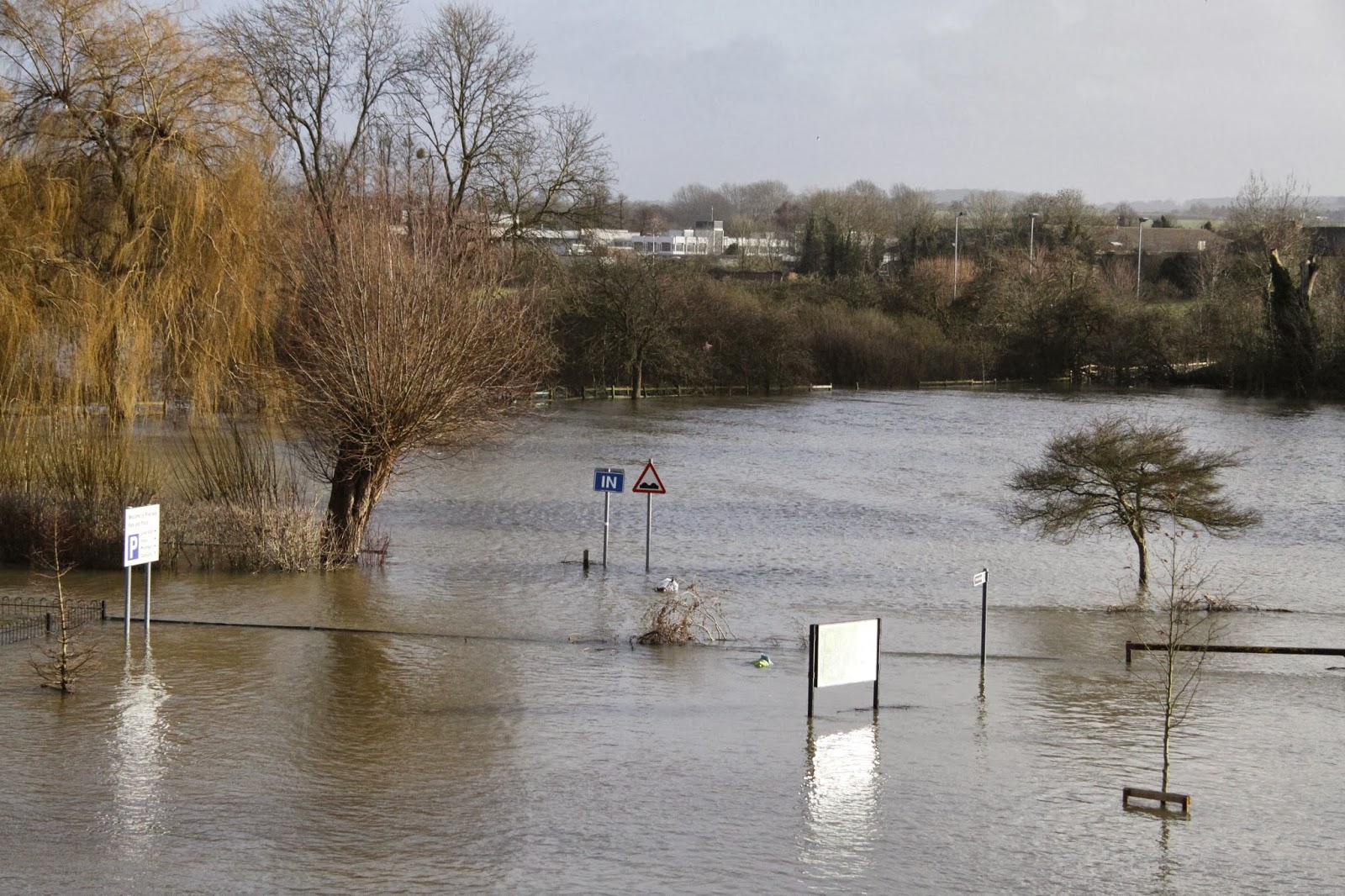 |
| Floodplain inundations have been extensive. Photo: Paulette Burns / Centre for Ecology & Hydrology |
None of the flooding in the last 50 years matches that experienced in March 1947 when a warm front brought moderate rainfall and a rapid increase in temperature which melted snow accumulations of >30cm across much of England & Wales. At that time, flood defences were rudimentary. Such floods are less likely to occur in a warming world and, although the frequency of high flows has increased in the last 50 years, there is no compelling long-term trend in annual maximum flows for UK rivers.
However, with sea levels rising (exacerbated by isostatic re-adjustment in some regions), the type of fluvial/tidal flooding recently experienced may be expected more frequently in the future.
With regard to the UK’s Water resources (which supply water for household and industrial use) the rainfall in December and early January has ensured that reservoir stocks are above average across almost all of the UK and groundwater levels have generally risen rapidly over the last six weeks. The water resources outlook for 2014 is therefore very healthy.
Terry Marsh, Centre for Ecology & Hydrology, 6 January 2014
Additional information
Key floods publications from CEH
Report - The 2010-12 drought and subsequent extensive flooding [PDF]
The section from pages 44-47 covers recent decades in the context of long-term trends for rainfall, runoff (river flows) and groundwater levels.
Report - The Summer 2007 floods in England and Wales [PDF]
Report - The 2000/2001 floods
Briefing Note - Understanding Floods [PDF]
Related links
CEH Blog: Rainfall, UK floods and the potential impacts of climate change?
Flickr: Photos of January 2014 flooding in Wallingford, Oxfordshire
*The National Hydrological Monitoring Programme (NHMP) aims to provide an authoritative voice on hydrological conditions throughout the UK, to place them in a historical context and, over time, identify and interpret any emerging hydrological trends. Such information is essential for improved water management strategies and its dissemination helps to increase public understanding of hydrological and water resources issues.
This is accomplished through regular monthly and annual bulletins, occasional reports on floods and droughts, and engagement with the media. Hydrological analysis and interpretation within the programme is based on the data holdings of the National River Flow Archive and National Groundwater Level Archive, including rainfall, river flows, borehole levels, and reservoir stocks.
The NHMP is run with the cooperation of the principal Measuring Authorities of the Environment Agency (England), Natural Resources Wales, the Scottish Environmental Protection Agency, and the Rivers Agency (Northern Ireland).
Amongst the NHMP outputs are:
- Hydrological Summary for the UK (monthly reports)
- Hydrological Review of the Year (annual report)
- Analyses and assessments of hydrological events (occasional reports)
NB: This post was edited on 9 January 2014 to include a new photograph of the flood level mark at Wallingford Bridge. All photos indicating the rising flood levels are available on our Flickr set.
Rainfall, UK floods and the potential impacts of climate change?
Water is again much in the news this week with widespread flooding across the UK following several weeks of very stormy weather. It's been a difficult time for many homeowners, particularly those by the coast, and the emphasis is now shifting to those living adjacent to several of our major river systems.
Yesterday (Sunday 5 January 2014), the Environment Agency published a news story naming the Thames, Dorset Stour and Frome, Somerset Levels, 'rivers' in the South East and the Severn as rivers where the flood threat remains into next week as larger rivers start to reach their peak.
CEH has already had calls from a number of journalists asking if the current weather and flooding patterns are anything out of the ordinary. CEH science and the data archives we host play a key role in informing the UK's operational agencies during this type of event. Within CEH we have teams of scientists working on furthering our understanding of hydrological processes, water resources, water information management, hydrological status and reporting, the climate system, hydrological modelling and risk, and hydrological modelling and forecasting.
A few examples include:
The Centre for Ecology & Hydrology jointly operates the National Hydrological Monitoring Programme (for the UK) in conjunction with the British Geological Survey. NHMP scientists produce the UK Monthly Hydrological Summary which assesses rainfall, river flows, groundwater and reservoir levels. They also operate the UK's National River Flow Archive. The NHMP also has a remit to analyse major flood and drought events in the UK and analyse long-term trends in UK hydrological data. The team publish a series of occasional reports on major hydrological events, including reports on the UK's major flood events in 2000/2001, 2007 and 2012.
The UK's Monthly Hydrological Summary is published on, or before, the tenth working day of the following month. A Hydrological Outlook for the UK is also available.
CEH's Grid-to-Grid (G2G)*, which is now used as the main hydrological model underpinning flood warning and forecasting by both the Environment Agency / Met Office Flood Forecasting Centre for England & Wales and the SEPA / Met Office Scottish Flood Forecasting Service for Scotland.
In 2012 CEH staff concluded a major project looking at "Future Flows and Groundwater Levels: British projections for the 21st century". The research looked at the impact of climate change on river flows and groundwater levels across England, Wales and Scotland and produced two unique datasets, which are now available via the CEH website, through the CEH Information Gateway and downloadable from the National River Flow Archive and National Groundwater Archive.
And finally on Friday 3 January, CEH climate scientist Chris Huntingford wrote this piece for the Guardian: "We desperately need to predict what climate change is doing to UK rainfall".
* The Grid-to-Grid hydrological model is a tool developed by the Centre for Ecology & Hydrology (CEH) for translating rainfall into river flows to predict potential river flooding. Intensive work on the Grid-to-Grid project began in 2002 at CEH and continues today in collaboration with the Environment Agency. Total NERC investment in the project (via CEH) is estimated at £1.2 million with additional funding provided by other organisations.
Further links
Jamie Hannaford from the Centre for Ecology & Hydrology contributed a chapter to the Living with Environmental Change climate change report card for water entitled, "Observed long-term changes in UK river flow patterns: a review"
More photos of the flooding at Wallingford, Oxfordshire (January 2014) on our Flickr photostream
Yesterday (Sunday 5 January 2014), the Environment Agency published a news story naming the Thames, Dorset Stour and Frome, Somerset Levels, 'rivers' in the South East and the Severn as rivers where the flood threat remains into next week as larger rivers start to reach their peak.
 |
| Flooding on the river Thames at Wallingford, Oxfordshire January 2014 |
A few examples include:
The Centre for Ecology & Hydrology jointly operates the National Hydrological Monitoring Programme (for the UK) in conjunction with the British Geological Survey. NHMP scientists produce the UK Monthly Hydrological Summary which assesses rainfall, river flows, groundwater and reservoir levels. They also operate the UK's National River Flow Archive. The NHMP also has a remit to analyse major flood and drought events in the UK and analyse long-term trends in UK hydrological data. The team publish a series of occasional reports on major hydrological events, including reports on the UK's major flood events in 2000/2001, 2007 and 2012.
The UK's Monthly Hydrological Summary is published on, or before, the tenth working day of the following month. A Hydrological Outlook for the UK is also available.
CEH's Grid-to-Grid (G2G)*, which is now used as the main hydrological model underpinning flood warning and forecasting by both the Environment Agency / Met Office Flood Forecasting Centre for England & Wales and the SEPA / Met Office Scottish Flood Forecasting Service for Scotland.
In 2012 CEH staff concluded a major project looking at "Future Flows and Groundwater Levels: British projections for the 21st century". The research looked at the impact of climate change on river flows and groundwater levels across England, Wales and Scotland and produced two unique datasets, which are now available via the CEH website, through the CEH Information Gateway and downloadable from the National River Flow Archive and National Groundwater Archive.
And finally on Friday 3 January, CEH climate scientist Chris Huntingford wrote this piece for the Guardian: "We desperately need to predict what climate change is doing to UK rainfall".
Additional information
* The Grid-to-Grid hydrological model is a tool developed by the Centre for Ecology & Hydrology (CEH) for translating rainfall into river flows to predict potential river flooding. Intensive work on the Grid-to-Grid project began in 2002 at CEH and continues today in collaboration with the Environment Agency. Total NERC investment in the project (via CEH) is estimated at £1.2 million with additional funding provided by other organisations.
Further links
Jamie Hannaford from the Centre for Ecology & Hydrology contributed a chapter to the Living with Environmental Change climate change report card for water entitled, "Observed long-term changes in UK river flow patterns: a review"
More photos of the flooding at Wallingford, Oxfordshire (January 2014) on our Flickr photostream
Friday, 20 December 2013
The top 10 most viewed CEH news & blog posts of 2013
We hope you've found our content interesting and informative throughout the year but, of course, not everything will be to everyone's tastes. Here is a little (slightly unscientific!) insight into what news and blogs you were reading the most in 2013, in traditional reverse order:
10. Distinctly autumnal feel to May as below average temperatures persist
The cold spring was still hanging around, but a warm summer wasn't too far away.
9. Ecologists get first bumblebees' eye view of the landscape
Scientists produced the most detailed picture yet of how bumblebees use the landscape, thanks to DNA technology and remote sensing.
8. Introducing the Hydrological Outlook
CEH and a number of partners had been working for a while on developing a long-range hydrological forecast for the UK.
7. Cocktail of multiple pressures combine to threaten the world's pollinating insects
Not one cause, but a combination of pressures including pesticides, disease and loss of food resources are threatening insect pollinators such as bumblebees and honeybees.
6. Are tropical forests resilient to global warming?
Tropical forests are less likely to lose biomass in response to greenhouse gas emissions over the 21st century than may previously have been thought.
5. Britain's rarest freshwater fish, the Vendace, reappears in Bassenthwaite Lake
The vendace made an unexpected reappearance in Bassenthwaite Lake in north-west England, more than a decade after being declared 'locally extinct'.
4. Tropical rainforests, 'lungs of the planet', reveal true sensitivity to global warming
The amount of carbon dioxide absorbed or produced by tropical rainforests varies hugely with year-to-year variations in the climate, revealing their vulnerability to climate change.
3. Smarter use of nutrients can help protect human health and the environment
A new report highlighted how humans have massively altered the natural flows of nitrogen, phosphorus and other nutrients, and how better management can help protect the environment, climate and human health.
2. Puffin count on Isle of May NNR gives surprising result
Despite severe spring weather, the worst fears for puffins weren't realised: a census revealed that Atlantic puffin numbers on the Isle of May National Nature Reserve off Scotland's east coast were at similar levels to 2009.
1. Mobile phone app to help monitor UK's native ladybirds after foreign invasion
iRecord Ladybirds, a free mobile phone app, was launched to help the public record ladybird species, including the invasive Harlequin ladybirds. All interest in the app, and a fantastic number of records, have been gratefully received by our scientists!
10. INTECOL news round-up: pollinators, citizen science and land use
A number of CEH staff presented at the 11th INTECOL Congress in London, the world's largest international ecology meeting, and this post tried to highlight what they said.
9. Cleaner air for all - searching for solutions to air pollution at Green Week 2013
Air quality was the theme for this year's event in Brussels, and CEH expertise was on hand to lead and join in with some of the discussions.
8. We're going on a Bug Hunt!
Science can be fun too, as ecologists and pupils taking part in a hugely successful Bug Day at a school near Rugby can confirm.
7. Filming at CEH's met site in Wallingford
Wet weather at the end of 2012 and into 2013 meant a busy start to the year for the CEH Press Office, with several media requests to interview our hydrologists.
6. Building environmental links in Beijing
Environmental researchers in China and the UK have signed a memorandum of understanding to explore collaboration opportunities. Recovery of polluted environments, water management, food security and soil management were all discussed during a meeting in April.
5. Biodiversity offsetting - the science behind the policy
More information on how CEH provides independent and impartial scientific advice for the tricky topic of biodiversity offsetting.
4. Nitrogen narratives in Nairobi - confessions of a reluctant blogger
Professor Mark Sutton experiences life at the sharp end of the science-policy debate.
3. A revolution in ladybird recording
Ladybirds are charismatic insects and so it isn't surprising that people in Britain have been enthusiastically recording them for centuries.
2. Assessing the 2013 Atlantic Puffin wreck
Our two most viewed blog posts of the year are actually on the same topic, indicating the huge interest at the time, and some of the uncertainty, around a puffin wreck in Eastern Scotland and NE England.
1. Puffin wreck in Scotland
Multiple unusual deaths of puffins were noticed on the east coast of Scotland NE England in the last week of March. One of the world's foremost authorities on puffin, Professor Mike Harris, gave insights into the emerging story.
You can read more about CEH research and news over the past twelve months in our annual review of the year on the CEH News Centre. Just a final thanks to all our contributors and, of course, to our readers. More to come in 2014 but in the meantime, Happy Christmas and best wishes for the New Year!
Paulette Burns and Barnaby Smith
Top 10 most viewed news stories
10. Distinctly autumnal feel to May as below average temperatures persist
The cold spring was still hanging around, but a warm summer wasn't too far away.
9. Ecologists get first bumblebees' eye view of the landscape
Scientists produced the most detailed picture yet of how bumblebees use the landscape, thanks to DNA technology and remote sensing.
8. Introducing the Hydrological Outlook
CEH and a number of partners had been working for a while on developing a long-range hydrological forecast for the UK.
7. Cocktail of multiple pressures combine to threaten the world's pollinating insects
Not one cause, but a combination of pressures including pesticides, disease and loss of food resources are threatening insect pollinators such as bumblebees and honeybees.
6. Are tropical forests resilient to global warming?
Tropical forests are less likely to lose biomass in response to greenhouse gas emissions over the 21st century than may previously have been thought.
5. Britain's rarest freshwater fish, the Vendace, reappears in Bassenthwaite Lake
The vendace made an unexpected reappearance in Bassenthwaite Lake in north-west England, more than a decade after being declared 'locally extinct'.
4. Tropical rainforests, 'lungs of the planet', reveal true sensitivity to global warming
The amount of carbon dioxide absorbed or produced by tropical rainforests varies hugely with year-to-year variations in the climate, revealing their vulnerability to climate change.
3. Smarter use of nutrients can help protect human health and the environment
A new report highlighted how humans have massively altered the natural flows of nitrogen, phosphorus and other nutrients, and how better management can help protect the environment, climate and human health.
2. Puffin count on Isle of May NNR gives surprising result
Despite severe spring weather, the worst fears for puffins weren't realised: a census revealed that Atlantic puffin numbers on the Isle of May National Nature Reserve off Scotland's east coast were at similar levels to 2009.
1. Mobile phone app to help monitor UK's native ladybirds after foreign invasion
iRecord Ladybirds, a free mobile phone app, was launched to help the public record ladybird species, including the invasive Harlequin ladybirds. All interest in the app, and a fantastic number of records, have been gratefully received by our scientists!
Top 10 most viewed blog posts
10. INTECOL news round-up: pollinators, citizen science and land use
A number of CEH staff presented at the 11th INTECOL Congress in London, the world's largest international ecology meeting, and this post tried to highlight what they said.
9. Cleaner air for all - searching for solutions to air pollution at Green Week 2013
Air quality was the theme for this year's event in Brussels, and CEH expertise was on hand to lead and join in with some of the discussions.
8. We're going on a Bug Hunt!
Science can be fun too, as ecologists and pupils taking part in a hugely successful Bug Day at a school near Rugby can confirm.
7. Filming at CEH's met site in Wallingford
Wet weather at the end of 2012 and into 2013 meant a busy start to the year for the CEH Press Office, with several media requests to interview our hydrologists.
6. Building environmental links in Beijing
Environmental researchers in China and the UK have signed a memorandum of understanding to explore collaboration opportunities. Recovery of polluted environments, water management, food security and soil management were all discussed during a meeting in April.
5. Biodiversity offsetting - the science behind the policy
More information on how CEH provides independent and impartial scientific advice for the tricky topic of biodiversity offsetting.
4. Nitrogen narratives in Nairobi - confessions of a reluctant blogger
Professor Mark Sutton experiences life at the sharp end of the science-policy debate.
3. A revolution in ladybird recording
Ladybirds are charismatic insects and so it isn't surprising that people in Britain have been enthusiastically recording them for centuries.
2. Assessing the 2013 Atlantic Puffin wreck
Our two most viewed blog posts of the year are actually on the same topic, indicating the huge interest at the time, and some of the uncertainty, around a puffin wreck in Eastern Scotland and NE England.
1. Puffin wreck in Scotland
Multiple unusual deaths of puffins were noticed on the east coast of Scotland NE England in the last week of March. One of the world's foremost authorities on puffin, Professor Mike Harris, gave insights into the emerging story.
You can read more about CEH research and news over the past twelve months in our annual review of the year on the CEH News Centre. Just a final thanks to all our contributors and, of course, to our readers. More to come in 2014 but in the meantime, Happy Christmas and best wishes for the New Year!
Paulette Burns and Barnaby Smith
Wednesday, 11 December 2013
CEH-led paper charts at number 42 in top 100 list of academic research catching the public's imagination in 2013
The company Altmetric has just published its list of the 100 research papers that received the most attention online in 2013. Altmetric track who's saying what about academic
papers within social media and online news articles. The analysis is embedded
in several journal websites, including those from the Nature Publications
Group.
Dr Chris Huntingford from the Centre for Ecology &
Hydrology was the lead author of the paper at number 42 on the Altmetric list,
"No increase in global temperature variability despite changing regional
patterns". It was published in July in the journal Nature.
Chris tells us that, "The study which led to the Nature
publication was a team effort, and the analysis took over a year to complete
with CEH kindly allocating me time to complete the final paper. The paper
provides insights into how variability in temperature is changing both in time
and geographically. Ongoing research into weather fluctuations and extremes
is needed, as changes in weather patterns might prove to be as important as any
general climate change in a greenhouse gas enriched environment. CEH and the
other NERC centre/surveys are working with the Met Office and key university
departments to aid public safety through such transitions. This will be by
informing of adaptation measures that may be needed."
Chris adds, "The titles of the top 100 papers make
fascinating reading as a snapshot of issues of concern or interest, and I would
recommend anyone with a spare moment to take a look at the list."
You can find out more about how Altmetric collect data and put
this list together on their blog. In true 'BBC style' we would like to point out there are many other ways of determining the 'impact' of a single research paper!
Barnaby Smith, Media Relations Manager, Centre for Ecology & Hydrology
Huntingford et al. (2013) No increase in global temperature variability despite changing regional patterns. 500, 327–330 (15 August 2013) doi:10.1038/nature12310Nature.
Thursday, 28 November 2013
Marine Climate Change scorecards published today for Coastal Margin habitats and Seabirds
The Marine Climate Change Impacts Partnership (MCCIP) published its latest Report Card today (28 November 2013), providing its most comprehensive assessment yet of how climate change is affecting UK waters. CEH coastal ecologists Dr Laurence Jones, Mr Angus Garbutt and Dr Francis Daunt are authors of the scorecards for coastal margins and seabirds, documenting the recent scientific evidence for what will happen in coastal habitats and on seabird populations under climate change. The coastal margin habitats include sand dunes, saltmarsh, machair systems, shingle and maritime cliffs.
All the coastal margin habitats are vulnerable to a wide range of climate impacts. Highly species-rich dune wetlands may dry out in the next 50 years and transform to dry grassland, with the potential loss of many rare species; while in dune and machair systems (a form of coastal grassland unique to Scotland and Ireland) there is evidence of erosional narrowing of beaches and dunes. Sea defence provided by saltmarsh, sand dunes and shingle will face increasing erosional pressure due to sea level rise and storms.
Seabirds have declined by 7.5% in the UK since the turn of the century, and climate warming is considered to be one of the main drivers by altering prey abundance and quality. Models predict that, by 2100, the UK climate will no longer be suitable for some species, with the range of others retracting to northern Scotland. Any increase in the frequency of extreme weather could further impact on seabirds by altering breeding habitat and creating unfavourable foraging conditions.
The scorecards are produced by the Marine Climate Change Impacts Partnership (MCCIP) and cover more than 30 marine and coastal topics. More than 150 scientists from 55 leading UK science organisations contributed to the 2013 report.
The scorecards are published annually, and provide latest updates on the evidence of recent change and best scientific projections of what is likely to happen in the near future. A summary of the findings for all UK marine and coastal habitats, and the detailed peer-reviewed briefings on all 33 topics can be found on the MCCIP website.
The Marine Climate Change Impacts Partnership was launched in March 2005 and is a partnership between scientists, government, its agencies, non-governmental organisations and industry.
A press release was issued to announce publication of the 2013 Report Card.
Related CEH links
Staff page of Dr Laurence Jones (sand dune expert)
Staff page of Angus Garbutt (saltmarsh expert)
Staff page of Dr Francis Daunt (seabird expert)
 |
| Sefton coast sand dunes |
Seabirds have declined by 7.5% in the UK since the turn of the century, and climate warming is considered to be one of the main drivers by altering prey abundance and quality. Models predict that, by 2100, the UK climate will no longer be suitable for some species, with the range of others retracting to northern Scotland. Any increase in the frequency of extreme weather could further impact on seabirds by altering breeding habitat and creating unfavourable foraging conditions.
 |
| Seabirds on the Isle of May |
The scorecards are produced by the Marine Climate Change Impacts Partnership (MCCIP) and cover more than 30 marine and coastal topics. More than 150 scientists from 55 leading UK science organisations contributed to the 2013 report.
The scorecards are published annually, and provide latest updates on the evidence of recent change and best scientific projections of what is likely to happen in the near future. A summary of the findings for all UK marine and coastal habitats, and the detailed peer-reviewed briefings on all 33 topics can be found on the MCCIP website.
Additional information
The Marine Climate Change Impacts Partnership was launched in March 2005 and is a partnership between scientists, government, its agencies, non-governmental organisations and industry.
A press release was issued to announce publication of the 2013 Report Card.
Related CEH links
Staff page of Dr Laurence Jones (sand dune expert)
Staff page of Angus Garbutt (saltmarsh expert)
Staff page of Dr Francis Daunt (seabird expert)
Thursday, 21 November 2013
New paper - The role of short-lived climate pollutants in meeting temperature goals
Dr Chris Huntingford, a climate modeller at CEH, is a co-author on a new paper in Nature Climate Change which examines whether immediately reducing emissions of methane, black carbon and other short-lived
climate pollutants will contribute substantially towards the goal of
limiting global warming to 2 °C above pre-industrial levels.
Chris writes: “There is tremendous interest at the moment in how emissions in non-CO2 gases can be reduced as a contribution towards constraining global warming. Peak levels of warming remain of particular concern, including whether we will remain below the often discussed threshold of two-degrees. Whilst any action on greenhouse gas emissions is of interest, what this paper finds is as follows. Reduction of short-lived gases as a mechanism to reduce peaks levels of global warming is most effective when CO2 emissions themselves are reducing significantly. Lowering methane emissions for instance (which has an atmospheric lifetime of around just 12 years) a long time before CO2-reductions are implemented is unnecessary - waiting until a time when CO2 emissions are also reducing will have the same effect on peak warming.
Chris writes: “There is tremendous interest at the moment in how emissions in non-CO2 gases can be reduced as a contribution towards constraining global warming. Peak levels of warming remain of particular concern, including whether we will remain below the often discussed threshold of two-degrees. Whilst any action on greenhouse gas emissions is of interest, what this paper finds is as follows. Reduction of short-lived gases as a mechanism to reduce peaks levels of global warming is most effective when CO2 emissions themselves are reducing significantly. Lowering methane emissions for instance (which has an atmospheric lifetime of around just 12 years) a long time before CO2-reductions are implemented is unnecessary - waiting until a time when CO2 emissions are also reducing will have the same effect on peak warming.
The argument implicit in this paper is that over the next few
decades, in terms of reducing peak warming, the emphasis really should remain
on tackling the longer-lived gases, and predominantly carbon dioxide, which by
definition have a more cumulative effect on climate. Reductions in short-lived
gases will be extremely useful too in restricting maximum warming, but working
out how to reduce them can maybe wait temporarily, leaving mitigation policy to
focus on carbon dioxide.”
You can read the paper on the Nature Climate Change website here.
Wednesday, 20 November 2013
Aiming for just enough Nitrogen (and not too much!)
Professor Mark Sutton from CEH is currently in Kampala, Uganda at the 6th International Nitrogen Conference, where he has joined other scientists, agriculturalists, environmentalists, industrialists, economists and policy-makers to discuss issues linked to nitrogen management, including food security, human health, agriculture and the water cycle. On Friday (22 November), it is planned that the Conference will finalize and announce the Kampala Declaration on global nitrogen management.
Prof Sutton chairs the International Nitrogen Initiative (INI) which has organised the conference with the African Nitrogen Centre, International Institute of Tropical Agriculture (IITA) and Makerere University College of Agricultural and Environmental Sciences. Also attending the conference are Prof Sutton's CEH colleagues Prof Nancy Dise and Dr Ute Skiba, each of whom are speaking at the event.
The conference, which runs from 18-22 November 2013, has the tagline "Let us aim for Just Enough N: Perspectives on how to get there for 'too much' and 'too little' regions".
Prof Sutton is chairing a session on Global and Regional Assessment and making a keynote speech "Global Nitrogen Assessment: From Our Nutrient World to the International Nitrogen Management System (INMS)". Our Nutrient World is the UNEP publication edited by Prof Sutton which was published by CEH earlier this year. It is planned that Prof Sutton will also moderate the finalization of the Kampala Declaration on Friday.
The Kampala meeting is believed to be the world's first 'Nitrogen Neutral' conference, where delegates are offered the opportunity to contribute offsetting their nitrogen footprint associated with the conference. At the same time, the delegates have adopted a demitarian approach - reducing their consumption of meat by half compared with the usual menu at the conference venue, the Speke Resort Hotel - as a means of reducing their own nitrogen footprint.
A key issue being discussed at the meeting is how to get more Nitrogen into Africa, with the main debate being that of fertiliser usage versus biological nitrogen fixation, and how to get the best from both aspects.
This is the sixth international conference to take place after previous events in the Netherlands, USA, China, Brazil and India. The common objective of these conferences is the design of more productive, economic and sustainable food and energy production systems to meet the challenges of the growing global population whilst minimising the cascade of environmental effects posed by nitrogen. Air pollution, water pollution, biodiversity and climate change are all impacted through "too much" nitrogen in the environment, but it is an essential part of the story to ensuring global good security.
The International Nitrogen Initiative is a global effort to optimize nitrogen's beneficial role in sustainable food production and to minimize nitrogen's negative effects on human health and the environment.
Prof Nancy Dise is speaking on "Impacts of nitrogen deposition on the ecology and biogeochemistry of European peat bogs: The PEATBOG Project" in a session on N and ecosystem health.
Dr Ute Skiba is speaking on "Comparison of N, C and GHG budgets from European forests, wetlands and agricultural land" in a session on N emissions and climate change.
Related links
Staff page of Prof Mark Sutton
Prof Mark Sutton was on the Steering Committee and Editorial Team, and was Part 2 Coordinator, of the new UNEP Synthesis Report, Drawing Down N2O to Protect Climate and the Ozone Layer, which was published on Thursday 21 November 2013, coinciding with the COP19 United Nations Climate Change Conference in Warsaw. Additionally, Dr Ute Skiba from CEH was a lead author on the new report, which aims to inform policymakers and stakeholders about the impacts of nitrous oxide (N2O) emissions on the climate and ozone layer. More details can be found from the UNEP press release.
Prof Sutton chairs the International Nitrogen Initiative (INI) which has organised the conference with the African Nitrogen Centre, International Institute of Tropical Agriculture (IITA) and Makerere University College of Agricultural and Environmental Sciences. Also attending the conference are Prof Sutton's CEH colleagues Prof Nancy Dise and Dr Ute Skiba, each of whom are speaking at the event.
The conference, which runs from 18-22 November 2013, has the tagline "Let us aim for Just Enough N: Perspectives on how to get there for 'too much' and 'too little' regions".
Prof Sutton is chairing a session on Global and Regional Assessment and making a keynote speech "Global Nitrogen Assessment: From Our Nutrient World to the International Nitrogen Management System (INMS)". Our Nutrient World is the UNEP publication edited by Prof Sutton which was published by CEH earlier this year. It is planned that Prof Sutton will also moderate the finalization of the Kampala Declaration on Friday.
The Kampala meeting is believed to be the world's first 'Nitrogen Neutral' conference, where delegates are offered the opportunity to contribute offsetting their nitrogen footprint associated with the conference. At the same time, the delegates have adopted a demitarian approach - reducing their consumption of meat by half compared with the usual menu at the conference venue, the Speke Resort Hotel - as a means of reducing their own nitrogen footprint.
A key issue being discussed at the meeting is how to get more Nitrogen into Africa, with the main debate being that of fertiliser usage versus biological nitrogen fixation, and how to get the best from both aspects.
This is the sixth international conference to take place after previous events in the Netherlands, USA, China, Brazil and India. The common objective of these conferences is the design of more productive, economic and sustainable food and energy production systems to meet the challenges of the growing global population whilst minimising the cascade of environmental effects posed by nitrogen. Air pollution, water pollution, biodiversity and climate change are all impacted through "too much" nitrogen in the environment, but it is an essential part of the story to ensuring global good security.
The International Nitrogen Initiative is a global effort to optimize nitrogen's beneficial role in sustainable food production and to minimize nitrogen's negative effects on human health and the environment.
Additional information
Prof Nancy Dise is speaking on "Impacts of nitrogen deposition on the ecology and biogeochemistry of European peat bogs: The PEATBOG Project" in a session on N and ecosystem health.
Dr Ute Skiba is speaking on "Comparison of N, C and GHG budgets from European forests, wetlands and agricultural land" in a session on N emissions and climate change.
Related links
Staff page of Prof Mark Sutton
Updated 22 November 2013
Prof Mark Sutton was on the Steering Committee and Editorial Team, and was Part 2 Coordinator, of the new UNEP Synthesis Report, Drawing Down N2O to Protect Climate and the Ozone Layer, which was published on Thursday 21 November 2013, coinciding with the COP19 United Nations Climate Change Conference in Warsaw. Additionally, Dr Ute Skiba from CEH was a lead author on the new report, which aims to inform policymakers and stakeholders about the impacts of nitrous oxide (N2O) emissions on the climate and ozone layer. More details can be found from the UNEP press release.
Monday, 28 October 2013
British lakes - boldly going where no lakes have gone before
Three scientists at CEH, Natural Resources Wales and Queen Mary University London discuss the findings of a collaborative lake ecosystems project:
This was one of the main messages derived from a recent workshop convened at the Centre for Ecology & Hydrology's Lancaster site by CEH and Queen Mary University of London (QMUL).
The purpose was to discuss the outcomes of a NERC-funded project, "Whole lake responses to species invasion mediated by climate change", with colleagues in the regulatory and conservation agencies: Natural Resources Wales, Scottish Natural Heritage, Natural England, the Environment Agency and the Cumbria Freshwater Invasive Non-Native Species Initiative. The research is based on Windermere, England's largest natural lake, where unrivalled long-term records and archives exist. The project builds on more than two decades of research on lakes around the world that have revealed that climate change is affecting a range of lake properties throughout the whole lake ecosystem and that some of the changes will be hard to forecast. More specific information can be found at the Windermere Science website.
The project found that climate change has:
These findings will directly inform the future management of one of the most important lakes in England. However, there are lessons to be learned as well, as many of the changes are likely to be common across lakes in different regions.
There was common agreement at the workshop that our lakes are a critical national resource delivering a range of ecosystem services, but they are under threat. In particular, they are sensitive to invasive species which favour already disturbed environments. The importance of having access to long-term datasets and archived samples was acknowledged but the insights they provide will be strengthened by using other techniques, such as stable isotopes to trace food-webs and by modelling. Other research priorities specific to invasive species included identification of introduction pathways, early detection, likely spatial and temporal impact of specific species, and the effectiveness of biosecurity measures.
Guest blog by Dr Catherine Duigan (Head of the Marine and Freshwater Ecosystems Group, Natural Resources Wales, Bangor, @NatResWales), Prof Stephen Maberly (Head of the Lake Ecosystems Group at CEH), and Dr Jonathan Grey (Reader in Aquatic Ecology, QMUL).
Windermere Science
Lake Ecosystems Group at CEH
"British lakes are on a new environmental trajectory. For the last half century scientists and managers have focused on how acidification and eutrophication affect the structure and function of lakes and their ecological quality. Now, as the effects of climate change are increasing in magnitude, it is interacting with other pressures, such as the expansion of non-native invasive species. We are therefore facing a situation where management strategies will need to be revised and restoration targets reconsidered as novel ecosystems emerge."
This was one of the main messages derived from a recent workshop convened at the Centre for Ecology & Hydrology's Lancaster site by CEH and Queen Mary University of London (QMUL).
The purpose was to discuss the outcomes of a NERC-funded project, "Whole lake responses to species invasion mediated by climate change", with colleagues in the regulatory and conservation agencies: Natural Resources Wales, Scottish Natural Heritage, Natural England, the Environment Agency and the Cumbria Freshwater Invasive Non-Native Species Initiative. The research is based on Windermere, England's largest natural lake, where unrivalled long-term records and archives exist. The project builds on more than two decades of research on lakes around the world that have revealed that climate change is affecting a range of lake properties throughout the whole lake ecosystem and that some of the changes will be hard to forecast. More specific information can be found at the Windermere Science website.
 |
| The John Lund - the CEH vessel used to carry out the long-term monitoring on Windermere. Photo: Dr Ian Winfield. |
The project found that climate change has:
- increased water temperature and prolonged the period of stratification
- favoured species, such as the roach, from southern latitudes
- disfavoured species, such as the Arctic charr, from northern latitudes
- changed the fish community, leading to altered fish diet and food-web linkages
- altered the zooplankton community structure
- led to earlier phytoplankton growth in the spring and later growth in the autumn
These findings will directly inform the future management of one of the most important lakes in England. However, there are lessons to be learned as well, as many of the changes are likely to be common across lakes in different regions.
 |
| Taking a zooplankton net tow. Photo: Dr Peter Smyntek |
There was common agreement at the workshop that our lakes are a critical national resource delivering a range of ecosystem services, but they are under threat. In particular, they are sensitive to invasive species which favour already disturbed environments. The importance of having access to long-term datasets and archived samples was acknowledged but the insights they provide will be strengthened by using other techniques, such as stable isotopes to trace food-webs and by modelling. Other research priorities specific to invasive species included identification of introduction pathways, early detection, likely spatial and temporal impact of specific species, and the effectiveness of biosecurity measures.
Guest blog by Dr Catherine Duigan (Head of the Marine and Freshwater Ecosystems Group, Natural Resources Wales, Bangor, @NatResWales), Prof Stephen Maberly (Head of the Lake Ecosystems Group at CEH), and Dr Jonathan Grey (Reader in Aquatic Ecology, QMUL).
Additional information
Windermere Science
Lake Ecosystems Group at CEH
Tuesday, 22 October 2013
National hydrometric data - what does the future bring for the UK's NRFA?
In two previous blog posts this month, we explored how the hydrometric data held by the National River Flow Archive and the National Groundwater Level Archive have been used in past and present scientific research, and how such a valuable data resource is vital for taking a long view of both hydrological trends and significant one-off events. Our series has coincided with a special meeting, on Tuesday 22 October 2013, to celebrate 30 years of the NRFA being hosted at CEH's Wallingford site. To conclude the series, Jamie Hannaford, head of the National River Flow Archive, looks to the future and at what the next few years might bring...
The past 30 years have seen incredible change in how we do our jobs, most obviously in the technology used to gather and disseminate hydrometric data. The next 30 years will undoubtedly see huge change again. When you think about it, 30 years is a generational timescale, it's a career span, it's a period that can expect to see life-changing developments. Hydrometric data and analysis is already important to society for underpinning effective water management, but it will assume even greater importance in global water management over the next 30 years, thanks to the challenges of population growth and movement, land use change and of climate change leading to an intensification of the hydrological cycle.
The NRFA, as the UK's national hydrometric information service, will be crucial to meeting these challenges, lying as it does at the heart of the hydrometric information lifecycle and managing as it does a long-term archive that will be able to take an ever longer view of events such as the 2010-2012 drought to flood transformation. Reliable, easily accessible, contextualised data and analysis will play a key role as scientists and water practitioners meet the world's water resource management needs.
From the original print publications the NRFA delivered in the 1980s, to the digital outputs it now provides, our data is already, and will continue to be, served in many formats, but our fundamental maxim will always be to turn the data into valuable information. We always make sure we know where the data is coming from, so we can guide our end users.
The technological landscape will certainly continue to develop. Will we be a nation of armchair hydrologists by 2043? In some respects, thanks to remote sensing and satellite capabilities, it's possible to some extent now. But as well as opportunities, technology brings its own challenges - both in the huge amount of data that can be gathered and in the interpretation and validation of that data. For all the hydrometric data that can be gathered, we still need to understand what it is telling us. And we still need our monitoring partners to collect data first-hand to complement the models and the satellite technology.
Future developments
An important area for the NRFA now is to look at how to integrate our river flow data with other types of monitoring, for example near real-time soil moisture data, citizen science initiatives etc, to build up a fuller environmental picture. Our role will be to bring these other types of information together with the river flows; to help with interpreting and understanding them in context with other environmental variables.
Currently we are reviewing our hydrological summaries and looking at different options for enhancement, for example using the best modelling capabilities from CEH and other organisations to deliver improved outlooks and better drought indicators. We are working more closely than ever with international colleagues in organisations such as the US National Drought Mitigation Center and CSIRO in Australia, and aim to improve the information that we and other national hydrometric data providers can supply. It is a challenging task to undertake when hydrometric networks are under pressure worldwide, along with the resources for long-term monitoring.
In the shorter term, you can expect the NRFA to offer daily catchment rainfall on its website from next year. We will also be taking on the validation for HiFlows-UK, the UK's principal source of flood peak data, and making this available from our website in the near future.
Who can really say what the NRFA in 2043 will look like? The last 30 years have been a tremendous effort of stewardship, and the next 30 years will be also, but we are ready and able for the challenge, thanks to the support of our partners. Our data and analysis has informed the likes of the Pitt Review on flooding, which followed the 2007 summer floods, as well as the National Ecosystem Assessment and the IPCC's recent 2013 climate change assessment. We will continue to give that much needed national, strategic assessment that is crucial for water management in this country.
Jamie Hannaford
Dixon, H, Hannaford, J and Fry, M J, 2013, The effective management of national hydrometric data: experiences from the United Kingdom. Hydrological Sciences Journal.
The 2010-2012 drought and subsequent extensive flooding - a remarkable hydrological transformation by Terry Marsh, Simon Parry, Mike Kendon & Jamie Hannaford. 2013. PDF [7.05mb]
Hydrometric data - the long view (first in our special blog series on the NRFA and hydrometric data)
An unprecedented hydrological transformation (second in our blog series)
View photos from the NRFA 30th anniversary event on Flickr
National River Flow Archive
Staff page of Jamie Hannaford, CEH
The past 30 years have seen incredible change in how we do our jobs, most obviously in the technology used to gather and disseminate hydrometric data. The next 30 years will undoubtedly see huge change again. When you think about it, 30 years is a generational timescale, it's a career span, it's a period that can expect to see life-changing developments. Hydrometric data and analysis is already important to society for underpinning effective water management, but it will assume even greater importance in global water management over the next 30 years, thanks to the challenges of population growth and movement, land use change and of climate change leading to an intensification of the hydrological cycle.
The NRFA, as the UK's national hydrometric information service, will be crucial to meeting these challenges, lying as it does at the heart of the hydrometric information lifecycle and managing as it does a long-term archive that will be able to take an ever longer view of events such as the 2010-2012 drought to flood transformation. Reliable, easily accessible, contextualised data and analysis will play a key role as scientists and water practitioners meet the world's water resource management needs.
 |
| The NRFA already provides its data and analysis in many formats |
From the original print publications the NRFA delivered in the 1980s, to the digital outputs it now provides, our data is already, and will continue to be, served in many formats, but our fundamental maxim will always be to turn the data into valuable information. We always make sure we know where the data is coming from, so we can guide our end users.
The technological landscape will certainly continue to develop. Will we be a nation of armchair hydrologists by 2043? In some respects, thanks to remote sensing and satellite capabilities, it's possible to some extent now. But as well as opportunities, technology brings its own challenges - both in the huge amount of data that can be gathered and in the interpretation and validation of that data. For all the hydrometric data that can be gathered, we still need to understand what it is telling us. And we still need our monitoring partners to collect data first-hand to complement the models and the satellite technology.
 |
| The provision of reliable hydrometric data in the 21st century will be crucial for global water management |
Future developments
An important area for the NRFA now is to look at how to integrate our river flow data with other types of monitoring, for example near real-time soil moisture data, citizen science initiatives etc, to build up a fuller environmental picture. Our role will be to bring these other types of information together with the river flows; to help with interpreting and understanding them in context with other environmental variables.
Currently we are reviewing our hydrological summaries and looking at different options for enhancement, for example using the best modelling capabilities from CEH and other organisations to deliver improved outlooks and better drought indicators. We are working more closely than ever with international colleagues in organisations such as the US National Drought Mitigation Center and CSIRO in Australia, and aim to improve the information that we and other national hydrometric data providers can supply. It is a challenging task to undertake when hydrometric networks are under pressure worldwide, along with the resources for long-term monitoring.
In the shorter term, you can expect the NRFA to offer daily catchment rainfall on its website from next year. We will also be taking on the validation for HiFlows-UK, the UK's principal source of flood peak data, and making this available from our website in the near future.
Who can really say what the NRFA in 2043 will look like? The last 30 years have been a tremendous effort of stewardship, and the next 30 years will be also, but we are ready and able for the challenge, thanks to the support of our partners. Our data and analysis has informed the likes of the Pitt Review on flooding, which followed the 2007 summer floods, as well as the National Ecosystem Assessment and the IPCC's recent 2013 climate change assessment. We will continue to give that much needed national, strategic assessment that is crucial for water management in this country.
Jamie Hannaford
Additional reading
Dixon, H, Hannaford, J and Fry, M J, 2013, The effective management of national hydrometric data: experiences from the United Kingdom. Hydrological Sciences Journal.
The 2010-2012 drought and subsequent extensive flooding - a remarkable hydrological transformation by Terry Marsh, Simon Parry, Mike Kendon & Jamie Hannaford. 2013. PDF [7.05mb]
Hydrometric data - the long view (first in our special blog series on the NRFA and hydrometric data)
An unprecedented hydrological transformation (second in our blog series)
View photos from the NRFA 30th anniversary event on Flickr
Related links
National River Flow Archive
Staff page of Jamie Hannaford, CEH
Subscribe to:
Posts (Atom)